
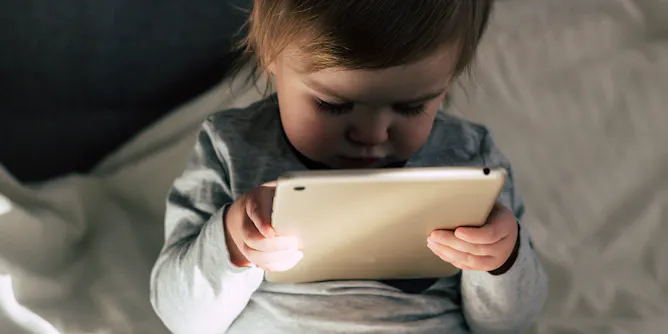
Young children may find it harder to control their attention if they use touchscreens regularly.
Articles on How babies learn
Displaying all articles
The flat screened babysitter is part of growing up.

Psychology researchers bring infants into the lab to learn more about how shared book reading influences brain and behavioral development.

Persistence and self-control are valuable traits that can help kids succeed in school and beyond. A new study suggests infants can learn stick-to-itiveness by watching adults persist in a difficult task.

Babies learn more than just your words.

Babies first learn to recognize the rhythm and intonation of language. The process begins in the womb, where the intonation patterns are transmitted to the baby through the fluids.
Children feel sympathy for others from an early age. Two development psychologists explain how children can learn, based on feelings of sympathy, how to act more thoughtfully.

What effect does music have on the developing brains of babies who haven’t even learnt to talk?
If you thought babies’ babbling was just nonsense, it’s time to think again.
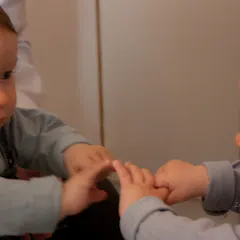
Research shows babies begin to learn language sounds before they’re even born. What about babies who hear two languages from birth? Can a baby brain specialize in two languages?

Some aspects of good parenting are universal, but others look very different from country to country. There needs to be a better understanding of parenting in different contexts.
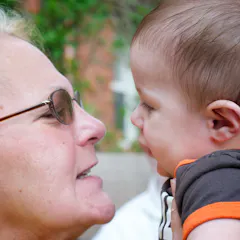
Just a few hours after birth, infants show a preference for human faces. Over the next few months, they learn from facial expressions.
Top contributors
-

Assistant Professor in English Linguistics, University of Graz
-
Post Doctoral Fellow, California State University, Dominguez Hills
-
Professor of Psychology, Cardiff University
-
Professor in Psychology, University of Florida
-
Professor, School of Psychology, University of Reading
-
Lecturer in Developmental & Health Psychology, Cardiff University
-
Psychologist - Infant Mental Health, University of the Witwatersrand
-
Research Scientist, University of Washington
-
Postdoctoral Associate, Duke University
-
Professor of Psychology, Rutgers University - Newark
-
Ph.D. Student in Brain and Cognitive Sciences, Massachusetts Institute of Technology (MIT)
-
Associate Professor of Psychology, University of Toronto
-
Postdoctoral Fellow, University of Washington
-
Lecturer in Developmental Psychology, City St George's, University of London
-
Professor, Department of Psychological Sciences, Birkbeck, University of London