
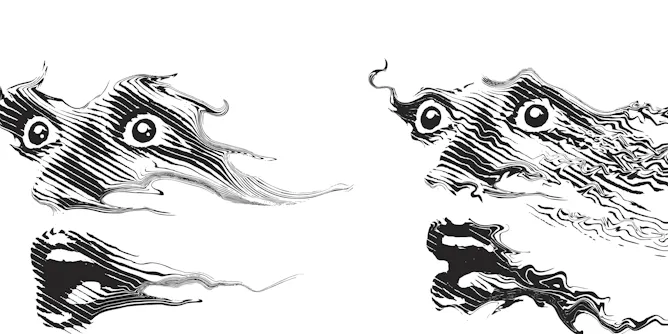
As the election nears, it seems everyone is afraid.
Articles on Homer
Displaying 21 - 40 of 55 articles
Much of what they said seems as relevant now as it did 2,000 years ago, even though we might question some of their methods.

In the ugly spectacle of American politics, it’s hard to keep humanity in sight. But literature, says a poet and scholar of the classics, can remind us of what we know about growing old.

Through a nuanced exploration of place, time, and memory, this new video work invites audiences to reflect on landscape and its relationship to the echoes of conflict.
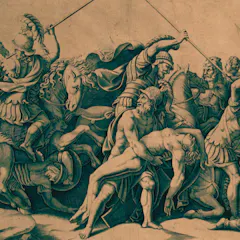
Reading Wilson’s Iliad, one senses something of the chant of Homer’s verse, even through the written word.

When Jane Gleeson-White’s marriage ended two years after her mother died, she lost her voice. Books by women writers like Rachel Cusk, Olivia Laing and Maggie Nelson helped her find it again.

Humanity is the only species on earth for whom intelligence is also an ethical liability.
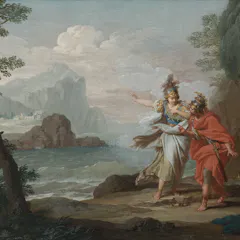
These books and poems give the women of the Odyssey a say and other new perspectives on the classic tale.

An ode to his hero Homer? The act of a man losing his sight? What is the story behind the famous Ulysses blue.
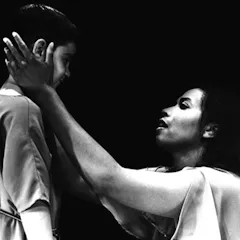
The Trojan Women is a genocide narrative. In this play, the great Athenian dramatist Euripides explores the enslavement of women, human sacrifice, rape and infanticide.

Rachel Hadas says that despite the cascade of scary news, humans will adapt, as they always have – and provides evidence of that resilience in the literature she loves and teaches.

A scholar of Greek literature writes why we need to turn to the past to understand the present – and the lessons that Homer’s hero, Odysseus, holds for us.

If you still haven’t seen this movie about a jazz pianist whose soul goes on a great adventure, it’s about time you did.

For hundreds of years, magicians believed cheese could help them foretell the future or identify a criminal.

Homer and Aeschylus turned to the divine to write their happy endings. But no gods are conspiring above the US, ready to swoop down and save humankind from itself.
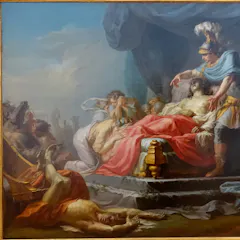
Families who lost their loved ones during the pandemic could not even properly grieve. Greek epics show why lamentation and memorial are so important and what we can learn in these times.

Perceptions about coronavirus “only killing old people” highlight the ageist way we sometimes refer to death and dying. Greek myth shows this isn’t new and ancient plays laid out the distinction.
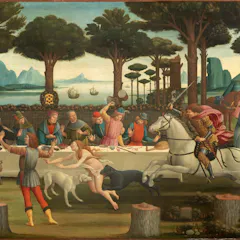
Western literature began with a plague and ever since, writers have been using pandemics to comment on society.
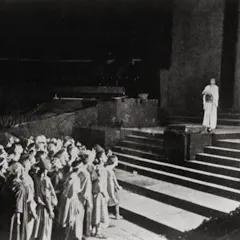
Greek epics remind audiences that leaders need to be able to plan for the future based on what has happened in the past. They need to understand cause and effect.
Anything is possible in the world of computers games – except women who fight, apparently.
Top contributors
-

Emeritus Professor of Classics, La Trobe University
-
Rachel Hadas is a Friend of The Conversation.
Professor of English, Rutgers University - Newark
-
Professor of Classical Studies, Brandeis University
-
Research Associate, Institute for Prehistory and Early History and Medieval Archaeology, University of Tübingen
-
Professor of Creative Arts, Griffith University
-
Research Associate, Curation and Communication, University of Tübingen
-
Doctoral Researcher, Physics, Universidade Estadual de Ponta Grossa (UEPG)
-
Associate Professor in Drama, The University of Queensland
-
PhD Candidate, University of Liverpool
-
Reader in Classical Studies, The Open University
-
Associate Professor of Ancient History, University of Leicester
-
Lecturer in Ancient History, Cardiff University
-
Associate Professor of Classics & Ancient History, University of New Brunswick
-
Chancellor's Professor of Medicine, Liberal Arts, and Philanthropy, Indiana University
-
University of Reading