

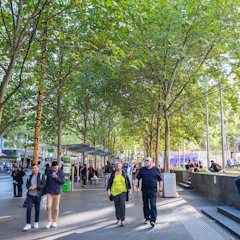
Even the type of street trees planted in a city can make a huge difference.
Articles on Healthy cities
Displaying all articles

Too often government policy is not designed with the long-term in mind. Instead, short-term economic outcomes and political gains are prioritised - to the detriment of public health.

From lit-up orbs to bland office blocks, cities are full of buildings that people do or do not like. What really shapes how they live – for better or for worse – is urban planning.

Cities can learn from past pandemics to see how communities and lifestyles are shaped by outbreaks.

The number of families living in high-rise, inner-city apartments is growing. Yet our research shows many parents find it challenging to raise children in such housing.

We searched Instagram for city images people associated with happiness. And they consistently included similar features, such as water, nature and heritage buildings.

The connections between city planning and health are many and varied, but getting health objectives integrated into all aspects of planning in New South Wales has been a long struggle.
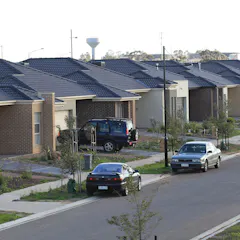
One of the most effective ways to reduce health inequalities across Australia is to design neighbourhoods that free residents from having to rely on cars for transport.

Traditionally, new communities first get hard infrastructure – schools, hospitals, transport – and ‘soft’ social infrastructure comes later. Liveability and public health suffer as a result.
The challenge of creating liveable communities across Australia’s capital cities comes down to seven key factors. And assessed on this basis, parts of our cities don’t fare so well.
Top contributors
-

Postdoctoral Research Fellow, Centre for Urban Research, RMIT University
-
PhD Candidate, Institute for Health and Ageing, Australian Catholic University
-
Senior Lecturer in Public Health, Victoria University
-
PhD researcher & Project Leader, Queensland University of Technology
-
Research Fellow, Centre for Urban Research, RMIT University
-
GIS Analyst, Centre for Urban Research, RMIT University
-
Professor of Built Environment, Institute for Health & Ageing, Australian Catholic University
-
Professorial Fellow, Mary MacKillop Institute for Health Research, Australian Catholic University; Emeritus Professor, Wertheim School of Public Health, University of California San Diego, University of California, San Diego
-
Distinguished Professor and Director, Urban Futures Enabling Capability Platform, and Director, Healthy Liveable Cities Group, RMIT University
-
Professor, Director Australian Urban Observatory, Centre for Urban Research, RMIT University
-
Research Officer, Healthy Liveable Cities Group, Centre for Urban Research, RMIT University
-
Associate Professor, Deakin University
-
Senior Research Fellow, Healthy Liveable Cities Group, Centre for Urban Research, RMIT University
-
Research Assistant, University of Sydney
-
Associate Professor in Urban and Regional Planning, University of Sydney