
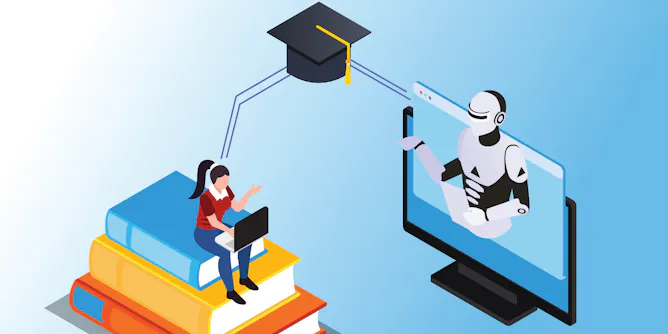
Instead of schools trying to replace teachers with AI, teachers could use AI to become better educators.
Articles on Generative AI
Displaying 21 - 40 of 254 articles
As schools consider AI guidelines, educators are also thinking about how they can adjust their assignments to accurately measure what students are actually learning.
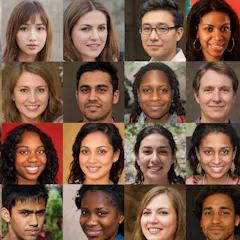
AI-generated faces don’t look weird anymore – they’re ‘hyperaverage’, which is a giveaway to the trained eye.

If AI is not designed properly, inequalities can reappear in new, digital forms.

In her Quarterly Essay, Anna Goldsworthy treats AI as a mirror rather than a monster. Is humanity wise enough to live with a technology that amplifies our weaknesses?

Several scientific fields rely on visual evidence to illustrate their claims. Inaccurate AI-generated images put the credibility of science at risk.

When AI hands us an answer, we risk bypassing the process through which learning happens.

Delivering on Ottawa’s AI for All strategy will require governments to build wraparound supports for workers, businesses and communities.

Generative AI systems show signs of being addictive, but the evidence is still at an early stage.

Not all deceptions are equal.

Researchers interviewed almost 30 religious leaders across all six major religious faiths in the UK to find out how AI was affecting them.

When AI is used to manufacture fake endorsements, copyright law doesn’t do enough to protect celebrities, influencers and other public figures.

For legal reasons, organisations require a human reviewer of generative AI outputs. But this human oversight must be valued and budgeted for in the transition to AI.
Urban design depends heavily on human judgment and field-based understanding.

It’s a relatively new legal tactic and not yet tested in court.

The evolution of technology and how it is used, or misused, is central to the study of pop production and performance.

AI’s apparent inability to generate interesting and unique images and videos is becoming harder to ignore.

The prospect of a massive IPO for OpenAI is about more than just a cash injection, it poses a broader ethical question: is market-driven AI a “safe” bet?

A new book for scholars, students, and curious readers invites readers to think critically about the promises and perils of language tech and examines AI’s impact on poetic practice.

Boycotts, sabotage and other types of civil disobedience have long served collective action against injustice.
Top contributors
-

Associate Professor of Visual Communication & Digital Media, RMIT University
-
Senior Lecturer in Law, University of New England
-
Associate Professor of Linguistics and Director of Language Lab, The University of Western Australia
-
Senior Lecturer in Law and Emerging Technologies, Western Sydney University
-
Senior Lecturer in Business Information Systems, University of Sydney
-
Professor of Philosophy and Director of Applied Ethics Center, UMass Boston
-
Professor in Computational Intelligence, Australian Catholic University
-
Adjunct Lecturer in Public Policy, Harvard Kennedy School; University of Toronto
-
Professor of Digital Communication, Director of QUT Digital Media Research Centre, Queensland University of Technology
-
Professor of Computer Science and Director of the Art & AI Lab, Rutgers University
-
Director of Sydney Executive Plus, Business School, University of Sydney
-
Professor of Computer Science, University of California, Berkeley
-
Associate Professor of Information Science, University of Colorado Boulder
-
Assistant Professor, Faculty of Business, University of New Brunswick
-
Associate Professor of Political Science, Brock University