
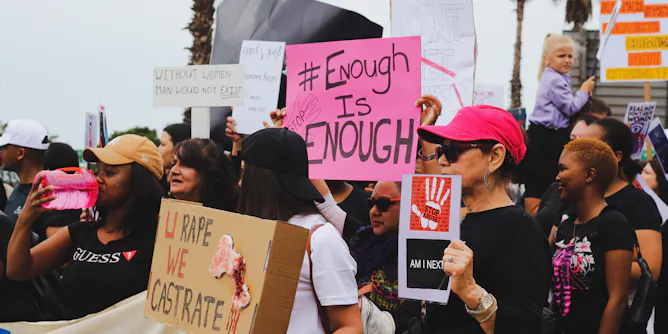
Protests and other acts of activism make visible groups and issues that are overlooked or deliberately ignored.
Articles on Gender-based violence
Displaying 61 - 80 of 287 articles

One recent analysis of almost 100,000 deepfake porn videos found South Korean women and girls featured in more than half.

New data from Victoria shows that in a quarter of deaths by suicide between 2009 and 2016, the person had experienced family violence before they died.

To achieve more diverse and inclusive sport environments, it is essential to prevent and appropriately respond to gender-based violence, including incidents of online public shaming.
National Cabinet unveiled a $4.7 billion partnership, starting July 1 2025, to address domestic violence. It’s funding that’s sorely needed and enthusiastically welcomed, but needed immediately.

Media messages normalise gender violence by teaching teenagers – girls and boys alike – that anger is linked to passion and attractiveness.

Within seconds, an app can turn anyone’s photo into an explicit image. The law is catching up to make this a criminal offence, but we need to do more.

Committing resources to violence prevention and services for victims/survivors is necessary to meet current and future needs.

Our research on school students’ sexist behaviour towards teachers shows some school leaders, colleagues and parents are downplaying harassment and abuse.

The largest South African survey of its kind has found that women in live music are often excluded from decision-making, receive unequal pay and face a range of aggressions.

Programs to help men to stop using violence are crucial, but are men meaningfully engaging with them? Our new study found opportunities to increase engagement, and in doing so, better protect women.

Publishing the faces and names of people accused of violence isn’t the best way of getting them to change their behaviour.

Mental health support is crucial for incel communities, however, associating incel violence with mental health and neurodivergence risks stigmatizing people with autism.

Women who have moved to Australia, particularly from traumatic settings, are particularly at risk of gendered violence. Here’s what our research found helps them to speak up.

Some countries closer to achieving gender equality still have high rates of domestic violence, but look a bit closer and you’ll see the full story.

Backed by an overwhelming majority, Claudia Sheinbaum has a unique opportunity to advance gender equality in Mexico.

Many people agree freedom of speech has its limits and the law has some role to play in prohibiting harmful speech. But what should these laws look like?

As Mexico elects its new president, gang violence continues to sprawl.

New technologies lead to new forms of gender-based violence such as cyberflashing, where survivors receive unsolicited explicit images. There is a need for legal and societal responses in response.

First Nations women are 32 times more likely to be hospitalised as a result of domestic violence than non-Indigenous women. We need to put Indigenous women at the centre of the discussion.
Top contributors
-

Professor of Family and Sexual Violence, RMIT University
-
Professor (Practice), Faculty of Business and Economics, Monash University
-
Professor of Political Science and Chair of the South African Research Initiative in Gender Politics, Stellenbosch University
-
Associate Professor in Criminology, The University of Melbourne
-
Adjunct Assistant Professor, Media and Technology Studies, and Director of the Feminist Collaboratory and Data Visualization Centre, University of Alberta
-
Professor, Department of Sociology & Anthropology, University of Guelph
-
Director of Monash Indigenous Studies Centre, Chief Investigator for the Australian Research Council Centre of Excellence for the Elimination of Violence against Women (CEVAW), School of Philosophical, Historical & International Studies, School of Social Sciences (SOSS), Monash University
-
Senior Lecturer in Global Studies, RMIT University
-
Assistant Professor, Global Development Studies, Queen's University, Ontario
-
Associate Professor, Indigenous Education & Research Centre, James Cook University
-
Associate Professor of Disaster and Emergency Management, York University, Canada
-
Criminologist / Senior Lecturer, Stellenbosch University
-
Senior lecturer, University of Exeter
-
Assistant Professor, Vrije Universiteit Amsterdam; Independent Social Research Foundation
-
Professor of Social Work; Leneen Forde Chair in Child & Family Research, Griffith University