
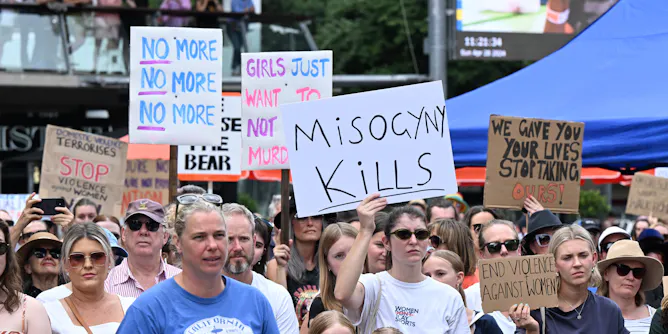
52 Australian women have lost their lives to violence this year, including three in recent weeks. How do we make sure we don’t get compassion fatigue?
Articles on Gender-based violence
Displaying 1 - 20 of 287 articles

Canada’s current framework treats deepfake-based sexual abuse as isolated criminal behaviour, when it is systematic gender-based violence.

Pressure to hold the family together, visa worries and fear of social exclusion can make it harder to leave abusive relationships.
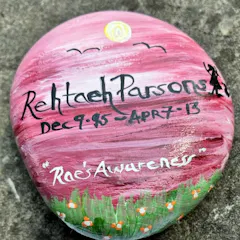
In her new book, media and technology academic Nicolette Little examines the impact of five Canadian grassroots multi-media projects.

Canada has a promising gender-based violence legal and policy framework, but none of it accounts for the people actually delivering frontline services.

Pauline Hanson’s comments amount to misinformation that risks stopping people from seeking help. Here are some of the facts.

Violence toward animals and people often occur together. Understanding these connections can improve safety and outcomes for both.

Gender-based violence responses must include energy access as a structural intervention, not an add-on.

Across the Indo-Pacific, countries are trying different approaches to men’s behaviour change programs for domestic violence. There are lessons for Australia.

Sweden, Denmark and Finland report much higher levels of gender-based violence than the EU average.

The language used in response to gender-based violence erases who’s doing the harm and who’s experiencing it, making it harder to report on and easier to excuse.

Thousands of men around the world, including in Australia, have formed online communities to trade in rape content and advice. They do it to impress one another.
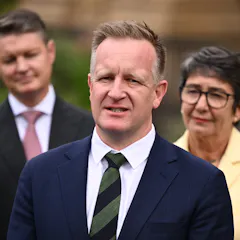
In a cabinet reshuffle, Paul Edbrooke has been appointed Victoria’s first minister for Men and boys. Academic evidence gives him some clear policy priorities.
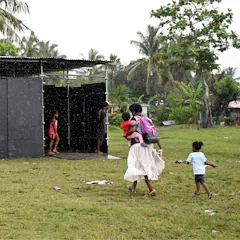
The Pacific has some of the highest rates of gender-based violence in the world. Smartphones, social media and AI deepfakes are where much of the abuse plays out.

For victim-survivors, court orders can help save their lives. But the system can be messy, open to abuse and the orders aren’t always enforced.

An Australian study of anti-feminist attitudes shows up to 30% of boys surveyed expressed agreement with various forms of violent extremism.

Latest data show First Nations women are much more likely to be killed than non-Indigenous women. It demands action.

Violence is interpreted through a double standard when it comes to trans people and cis men, allowing masculinity as a structural driver to remain unexamined.

Without intervention, we risk hardcoding human misogyny into the digital infrastructure of everyday life.

AI does not simply revive, but rewrites, repurposes and redistributes the dead. And this is marked by a lingering sadness.
Top contributors
-

Professor of Family and Sexual Violence, RMIT University
-
Professor (Practice), Faculty of Business and Economics, Monash University
-
Professor of Political Science and Chair of the South African Research Initiative in Gender Politics, Stellenbosch University
-
Associate Professor in Criminology, The University of Melbourne
-
Adjunct Assistant Professor, Media and Technology Studies, and Director of the Feminist Collaboratory and Data Visualization Centre, University of Alberta
-
Professor, Department of Sociology & Anthropology, University of Guelph
-
Director of Monash Indigenous Studies Centre, Chief Investigator for the Australian Research Council Centre of Excellence for the Elimination of Violence against Women (CEVAW), School of Philosophical, Historical & International Studies, School of Social Sciences (SOSS), Monash University
-
Senior Lecturer in Global Studies, RMIT University
-
Assistant Professor, Global Development Studies, Queen's University, Ontario
-
Associate Professor, Indigenous Education & Research Centre, James Cook University
-
Associate Professor of Disaster and Emergency Management, York University, Canada
-
Criminologist / Senior Lecturer, Stellenbosch University
-
Senior lecturer, University of Exeter
-
Assistant Professor, Vrije Universiteit Amsterdam; Independent Social Research Foundation
-
Professor of Social Work; Leneen Forde Chair in Child & Family Research, Griffith University