
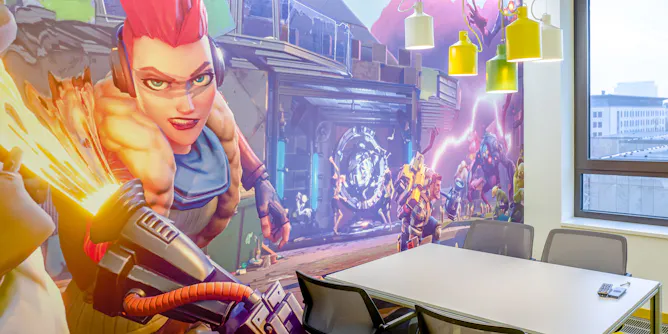
University course designers are harnessing the addictive quality of video games to develop ‘Serious educational games’ that engage and motivate students.
Articles on Gamification
Displaying 21 - 32 of 32 articles

If innovations of our digital age are largely to blame for decreasing attention spans, don’t they also hold possible solutions?

Making education more like playing a game could dramatically improve learning.

How zombies and gaming can help students learn.

CC BY-ND32.7 MB (download)
In this month's episode of The Anthill, we are playing games – computer games, grammar games and real life games, too.

Using elements of game play, we can create incentives for people to change how and when they make various transport choices in ways that enable the whole system to work better.

The human psyche loves a challenge as well as a pat on the back for achievement. Pervasive computing taps into these drives to ‘gamify’ aspects of life that are typically not games or even much fun.

Introducing game-like elements into classrooms can boost student motivation and learning.

Children’s insatiable curiosity and search for new knowledge is getting lost somewhere along the way. We’ve mislaid the art of the question.

There may be a chemical secret to getting kids interested in learning – and it’s one that’s created and produced by our own bodies rather than in a lab.

We’re hardwired to love finding patterns, solving puzzles, mastering challenges. Business, education, health, marketing and other fields tap into these drives via game elements to help us hit goals or change behavior.

A few days ago, I was an astrophysicist and contributed to a research project by organising sunspot images in order of complexity. After I’d had enough of that, I became a biochemist and worked late into…
Top contributors
-

Associate Professor in Education & Technology, University of KwaZulu-Natal
-
Assistant professor, business management, University of Edinburgh
-
Senior Lecturer in Software Engineering, Graphics and Multimedia, Sheffield Hallam University
-
Senior Lecturer in Psychology, Bangor University
-
Professor in Behavioural Neuroscience, Bangor University
-
Professor & Director, Hub for Apple Platform Innovation (HAPI), School of Computing Technologies, RMIT University
-
Contract Lecturer in Digital Media, Toronto Metropolitan University
-
Senior lecturer, Monash University
-
Research Lead and Fellow, National Institute of Economic and Social Research
-
Senior Lecturer in Sociology, Manchester Metropolitan University
-
Assistant Professor, National Yang Ming Chiao Tung University, Taiwan, Griffith University
-
Mathematics, Computer Science, Science, Engineering, Architecture, Laurentian University
-
Professor of Legal Studies and Business Ethics, University of Pennsylvania
-
Researcher, Department of Education, University of York
-
Junior Research Fellow, Hatfield College, Durham University