
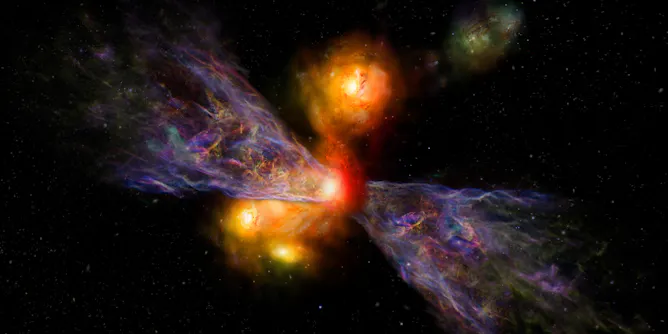
All things die, even galaxies.
Articles on Galaxy
Displaying 1 - 20 of 25 articles
Scientists have discovered the most distant hydroxyl megamaser ever detected. This is a natural space laser.

Seeing a signal in different kinds of light is like having a text written in several forms of writing – it makes it easier to decipher.
Astronomers want to understand how spiral galaxies form and get their massive spiral arms.
With college students less likely to read through a full textbook than they once were, video games can help keep them engaged.
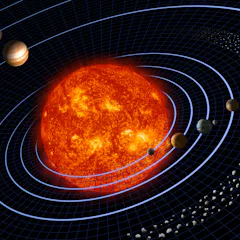
Which way is ‘down’ has a different answer depending on where you are on Earth, in the solar system, in our galaxy and beyond.
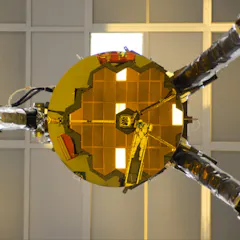
The only Australian hardware on board the legendary telescope is starting to fulfil its duties.
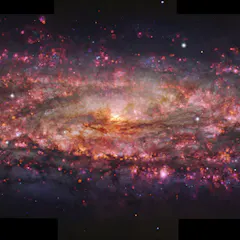
Researchers stitched together hundreds of images from the Very Large Telescope to form a breathtaking photo of a nearby galaxy.
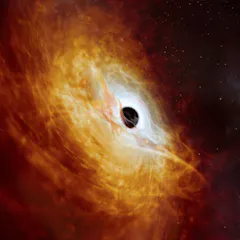
These small galaxies are either crammed with stars or they host gigantic black holes. The data astronomers have collected continues to puzzle them.
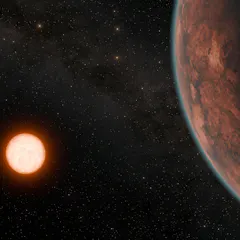
The groundbreaking discovery of a temperate Earth-size planet just 40 light-years away may hold the key to understanding stellar habitability.
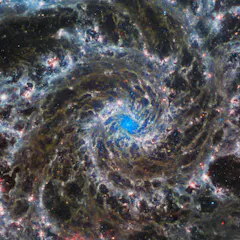
Recent research shows the main alternative theory to dark matter, Milgromian dynamics, is failing.
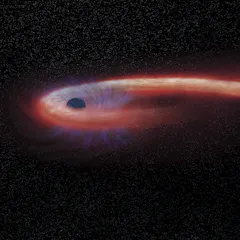
The extreme object could tell us more about the environment around black holes.
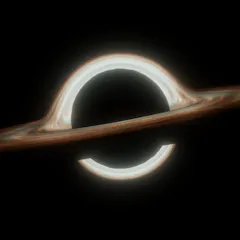
Pictures of black holes have a white outline around them when photographed, due to one of black holes’ unique and key features.

New data from the IceCube collaboration shows neutrino emissions from within our Milky Way galaxy – but figuring out where exactly these ghost particles come from is harder than it seems.

The current race to the Moon is opening up opportunities for lunar astronomy.

Our galaxy should be full of traces of dead stars. Until now, we have found surprisingly few of these supernova remnants, but a new telescope collaboration is changing that.
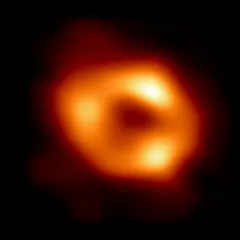
Sagittarius A* is a massive black hole at the center of the Milky Way. Now that astronomers have imaged it, they can begin to learn more about black holes within other galaxies across the universe.

The Orion Star Count 2022 calls on us to go outside and count the stars of Orion.

The largest orbital telescope ever made will allow astronomers to study the atmospheres of alien planets, learn about how stars form in the Milky Way and peer into the farthest reaches of the universe.
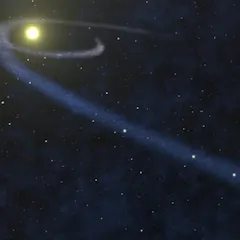
Thanks to the discovery of five twinkling galaxies in a rare alignment, astronomers have been able to calculate — for the first time — the properties and geometry of an invisible gas cloud in space.
Top contributors
-

University Distinguished Professor of Astronomy, University of Arizona
-
Pre-Doctoral Researcher, Edinburgh Napier University
-
Professor of Astronomy, Macquarie University
-
Professor of Computing, Edinburgh Napier University
-
Astrophysicist, University of Sydney
-
Associate Professor of Physics & Astronomy, University of California, Los Angeles
-
Lecturer in Sound Design, Edinburgh Napier University
-
Lecturer in Astronomy, Nottingham Trent University
-
Postdoctoral Research Fellow in Astrophysics, University of Portsmouth
-
PhD Candidate, The University of Queensland
-
Senior Research Fellow of Cosmology, University of Portsmouth
-
PhD student, University of Sydney
-
Professor of Planetary Science and Astrobiology, Birkbeck, University of London; Honorary Associate Professor, UCL
-
Postdoctoral Researcher, Astrophysics, McGill University
-
Professor (Astrophysics), University of Southern Queensland