
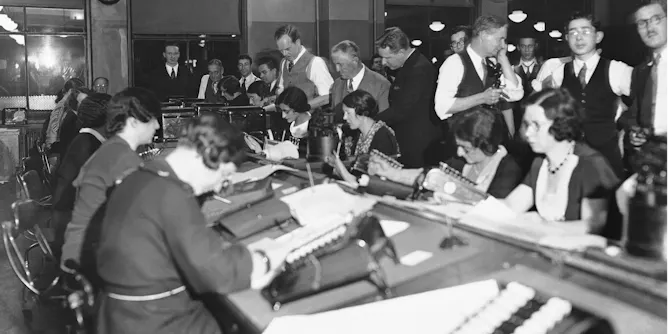
Journalists want to be first to tell the public who won, but the 2020 election night news frenzy may be very different from past years’ coverage.
Articles on Franklin Delano Roosevelt
Displaying 41 - 60 of 97 articles
Though critics claim Amy Coney Barrett’s nomination jeopardizes the high court’s legitimacy, research shows there are ways the judiciary can bolster its standing and weather controversial decisions.
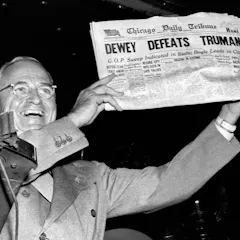
Presidential pollsters in the US have had some embarrassing failures. Here’s a catalog of those miscalls, from the scholar who literally wrote the book on them.
President Trump was direct in announcing he had COVID-19. But presidents in the past have been very good at deceiving the public about the state of their health. Which direction will Trump go now?
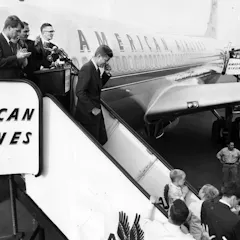
Though air travel has boosted presidential campaigns for decades, the 2020 pandemic has underlined the importance of aircraft as the quickest and safest way to campaign.
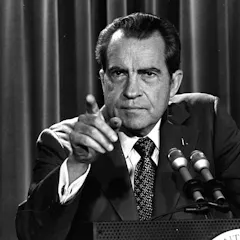
Some presidents have lied for honorable reasons, while for others the lies have been simply self-serving.

President Woodrow Wilson told Black leaders, ‘Segregation is not a humiliation but a benefit, and ought to be so regarded by you gentlemen.’ He was one in a long line of racist American presidents.
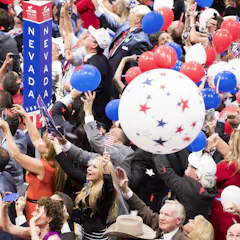
Political conventions used to pick presidential nominees in private. Now the public picks the nominee and then the party has a big party at the convention, writes a scholar of US elections.
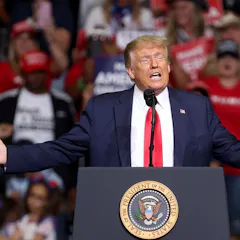
The absence of trust in a nation’s leader and government jeopardizes an effective response to a health crisis. It also creates a political crisis, a loss of faith in democracy.
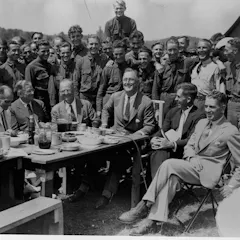
Similarities between the 1930s and today are hard to ignore, but Franklin D. Roosevelt’s New Deal teaches us that several developments have to coincide to generate a lasting social safety net.

You’ve heard of compulsory purchase orders for houses, but few realise it has sometimes happened with the world’s favourite precious metal.

Everything you ever wanted to know about the big G.
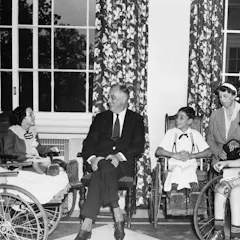
Franklin Delano Roosevelt’s personal battle with polio, and his steady hand while overseeing a national eradication campaign, highlights decisive leadership against a virus that terrified America.

This isn’t the first time sports have been put on hold. But in the past, the reprieve was brief, and sports went on to act as a way to bring Americans together. This time’s different.

The ‘tough guy’ is a cultural archetype that political leaders have long adopted. But during crises, Americans tend to look for a different kind of hero.
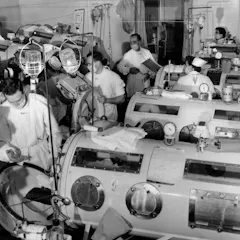
Polio was nearly eradicated with the Salk vaccine in 1955. At the time, little was known about this mysterious disease that paralyzed and sometimes killed young children.
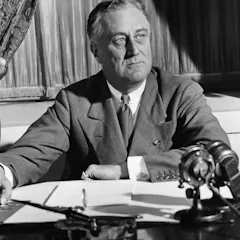
On March 12, 1933, President Roosevelt addressed the nation from the Oval Office during a time of great crisis. That ‘fireside chat’ proved broadcasting’s power as nothing before or since.

The T-Mobile-Sprint merger is the latest example of weakened enforcement of antitrust laws, which reduces competition and exacerbates already-record levels of inequality.
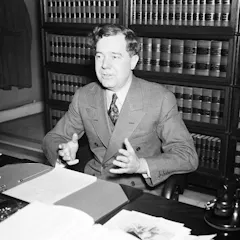
The very first scientific horse race poll, which took place 85 years ago, was shrouded in secrecy and may have changed history – even though it was faulty.
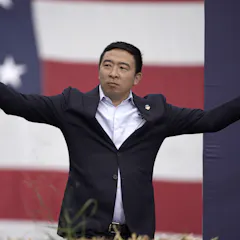
Francis Townsend had a similar if less ambitious idea in the 1930s that never got through Congress but ended up making Social Security a lot more generous.
Top contributors
-

Professor of Sociology, University of California, Irvine
-
Adjunct Professor of History and Affiliated Faculty, USC Shinso Ito Center for Japanese Religions and Cultures, USC Dornsife College of Letters, Arts and Sciences
-
Professor of History and Law Faculty, The Ohio State University
-
Professor of Communication and Journalism, University of Maine
-
Professor of History & American Culture Studies, Washington University in St. Louis
-
Associate Professor of Political Science, Westminster College
-
Assistant Professor of Media, Communications and Journalism, California State University, Fresno
-
Professor of Philosophy, Public Policy and Governance, University of Washington
-
Professor of History, Penn State
-
Professor of International Politics, University of Manchester
-
Associate Professor of 20th Century American History, Binghamton University, State University of New York
-
Professor of Global Politics and Anti-Slavery, University of Nottingham
-
Reader in US History, Northumbria University, Newcastle
-
Professor of History, McGill University
-
Dean, USC Dornsife College of Letters, Arts and Sciences