
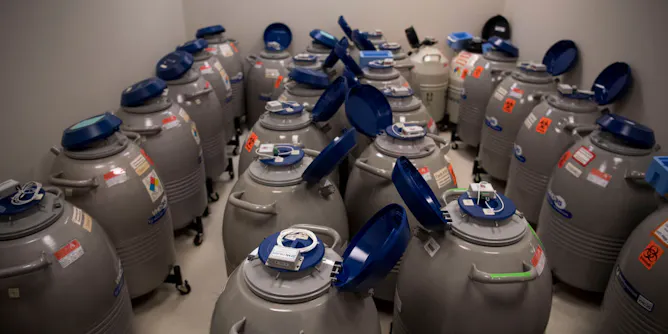
In vitro fertilization has become a bigger part of reproductive rights debates as a once-fringe movement to recognize embryos as people grows louder.
Articles on Fertility treatment
Displaying 1 - 20 of 24 articles

A day of celebration for many, it is also a source of anxiety for those whose hopes of motherhood have been dashed by infertility, loss, and those who have chosen unconventional paths to parenthood.

A new study looked at cancer rates in 417,984 women who’d had fertility treatment and compared them to cancer in the general population of women.

Men’s sperm numbers and fertility also decline with age. If you’re planning to have kids in the future, here’s what you need to know.

The review recommended an independent accreditation body as a priority. But there are notable gaps, including no mention of a national donor register.

By making small but intentional shifts in how we communicate, we can help ensure that individuals experiencing infertility feel supported rather than dismissed or pressured.

Māori and Pacific women are particularly disadvantaged by the BMI limit on access to public fertility treatment. Research shows Polynesians are much leaner than Europeans at significantly higher BMIs.

Research shows reproductive health issues are having an impact on the workplace and potentially the economy.

In the past, when courts considered disputes over what to do with no-longer-wanted embryos, they typically considered them property. The Alabama ruling challenges this legal precedent.

Alabama’s case began when three couples sued an IVF clinic where their frozen embryos had accidentally been dropped.

Scientists can create viable eggs from two male mice. In the wake of CRISPR controversies and restrictive abortion laws, two experts start a dialogue on ethical research in reproductive biology.
Previously, eggs and sperm (gametes) and embryos were typically only stored for a maximum of ten years.

Frozen eggs will be stored for up to 55 years in the UK.

For some people, accessing their super early for fertility treatments is their only chance to start or extend their family. And they need better protection.

Our new study shows a widely used fertility treatment, known as ICSI, is no better than standard IVF for most people. Yet, it’s being routinely offered around the world.

COVID-19 has led to a sharp rise in inquiries at some of London’s largest fertility clinics.

Most people don’t intend to be hurtful or insensitive in their conversations with people experiencing infertility — they often just don’t know what to say.

Women face extraordinary difficulty in seeking the birth control method of sterilization due to sexist reproductive norms.

Study results examining the effect of antioxidants on sperm health are mixed.

Although the number of children conceived through in vitro fertilisation born with abnormalities remains extremely low, a recent study in Kenya shows that the risk of genetic disorders is higher.
Top contributors
-

Assistant Professor of Anthropology, University of Texas at Arlington
-
Senior Lecturer in the Department of Obstetric and Gynaecology, University of Nairobi
-
Senior Lecturer in Exercise and Sports Science, Edith Cowan University
-
PhD, Political Science, Western University
-
Associate Professor of Law (Health Law), Deakin University
-
Professor of Health Law, Public Health Law and Medical Ethics, University of South Florida
-
Professor of Bioethics and Health Research, University of Manchester
-
Professor of Law, Penn State
-
Lecturer in Women's Health, UCL
-
Assistant professor, Psychology, University of Regina
-
Senior Lecturer, School of Social Sciences and Humanities, Loughborough University
-
Associate Professor of Anthropology, Purdue University
-
Emeritus Professor of Reproductive and Periconceptual Medicine, The Robinson Research Institute, Adelaide University
-
Reader in Human Reproductive Biology, University of Birmingham
-
Clinical Senior Lecturer and Consultant in Reproductive Medicine, UCL