

Researchers design studies that might disprove what’s called their null hypothesis – the opposite of the claim they’re interested in exploring.
Articles on False negative
Displaying all articles

Making rapid antigen tests for COVID-19 cheaper and more accessible can catch the infectious cases before they spread and help everyone resume normal activities safely.
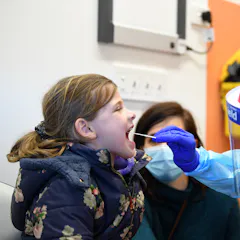
A man in the Northern Territory recently received a “weak positive” test result for COVID-19. Understanding how coronavirus tests work shows us why this can happen from time to time.
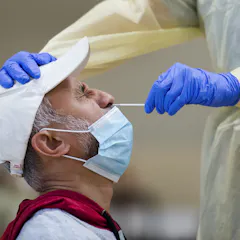
Understanding terms like sensitivity and specificity can help us make sense of COVID-19 testing, the accuracy of tests and what the results mean.
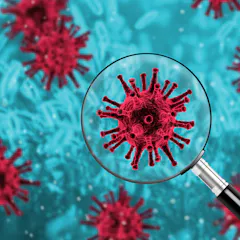
Testing large numbers of people regularly would reduce the spread of the coronavirus in the US. Laboratory testing is slow and expensive, but rapid screening tests could be the answer.
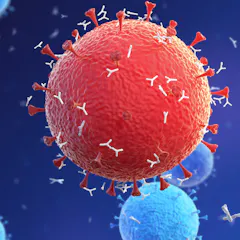
An antigen test was given emergency use authorization by the FDA in early May. A biochemist explains how COVID-19 antigen tests work.

As we start to test people without symptoms for COVID-19, the likelihood of generating false positive tests goes up. Here’s why that’s a problem.
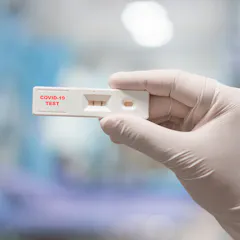
Expanding coronavirus testing is one of the most important tasks public health officials are tackling right now. But questions over accuracy of the two main types of tests have rightly caused concern.

A test that tells you with 94% accuracy that you have had coronavirus seems like a game-changer…until you do the maths.
Top contributors
-

Associate Professor of Public Policy, University of Maryland, Baltimore County
-
Epidemiologist, WHO Collaborating Centre for Viral Hepatitis, The Peter Doherty Institute for Infection and Immunity
-
Associate Professor of Biology and Biochemistry, University of Richmond
-
Director, WHO Collaborating Centre for Viral Hepatitis, The Peter Doherty Institute for Infection and Immunity
-
PhD Candidate, Epidemiology, Queen's University, Ontario
-
Associate Professor of Biology, Rochester Institute of Technology
-
Epidemiologist, WHO Collaborating Centre for Reference and Research on Influenza
-
Assistant Research Professor of Health Policy and Administration, Penn State
-
Professor of Mathematical Biology and Public Engagement, University of Bath