

Biases contained within historical datasets makes addressing what underpins automated decisions difficult – defining what is ‘fair’ is key.
Articles on Fairness
Displaying 1 - 20 of 44 articles

Treating consumers of financial products and services fairly seems uncontroversial. But translating it into a legal obligation can have unintended consequences.

Researchers found that when salespeople perceived their leaders as ethical, they felt more committed to the organization.

Australia’s highest court has ruled judges are immune from being sued for damages. Is it good public policy?

Support and opposition to Christian nationalism are linked to people’s moral values more than religious, racial and political tribalism.

People from many different cultures across the globe and across millennia largely agree about which body parts are most valuable – and how much compensation they warrant when injured.

Economists have traditionally viewed inequality through those directly affected or distant observers. But the informed-consumer perspective offers a path to reduce inequality through purchases.

The African story is not just about conflict, corruption, poverty, poor leadership, bad politics and disease. Its coverage should be more nuanced.

The court covered itself in glory in the first 15 years, but its performance has been patchy since then, coinciding with Jacob Zuma’s presidency.

College athletes have made substantial progress in being able to get paid for the use of their name, image and likeness − except in one realm.

Bias in AI has been getting a lot of attention lately, but it’s just one aspect of the larger – and thornier – problem of fairness in AI.

Electoral redistricting is a high-stakes political game, so Democrats and Republicans have a hard time playing fair. When they’re made to work together, a more representative result is possible.

The preference for fairness emerges early in childhood, suggesting it is to some extent hardwired.

Biased algorithms in health care can lead to inaccurate diagnoses and delayed treatment. Deciding which variables to include to achieve fair health outcomes depends on how you approach fairness.

A scholar of grading explains how teachers can do a better job of reporting what grades represent, and what they are for.

A new study reveals wide disparities among state-issued Clean Water Act fines, and even among federal fines from regions to region. A law professor explains why it may be illegal.

People who have a strong sense of fairness are less likely to cheat.

Perceptions that South African police treat people disrespectfully, lack impartiality or transparency, and are prone to brutality
undermine public confidence in them.
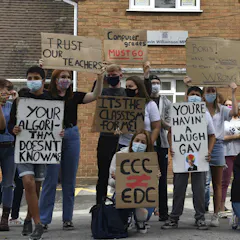
A UK controversy about school leavers’ marks shows algorithms can get things wrong. To ensure algorithms are as fair as possible, how they work and the trade-offs involved must be made clear.

As young children learn about politics and political figures, they internalize the idea that politics is a man’s world, which ultimately means political representation is heavily skewed toward men.
Top contributors
-

Visiting Researcher, University of Huddersfield
-
Associate Professor in Public Law, University of Cape Town
-
Lecturer in Public Policy, University of Michigan
-
PhD Student in Mathematics, University of Illinois Chicago
-
Senior Lecturer, Durham University
-
Senior Project Manager, Murdoch University
-
Bernard A. Galler Collegiate Professor of Electrical Engineering and Computer Science, University of Michigan
-
Research Associate, Southern Centre for Inequality Studies, University of the Witwatersrand, University of the Witwatersrand
-
Professor of Economics at New York University Abu Dhabi and Distinguished Research Professor, University of Technology Sydney
-
Professor of Economics, University of Alabama
-
Professor of History and Politics, School of Humanities and Social Inquiry, University of Wollongong
-
Research Fellow at the Centre for Human Evolution, Cognition, and Culture, University of British Columbia
-
Professor Emeritus of Public Law, University of Cape Town
-
Vasti Roodt is Associate Professor and Head of PROSPER (Promoting Social and Political Ethics Research) in the Department of Philosophy, Stellenbosch University
-
Professor of Management, University of Essex