
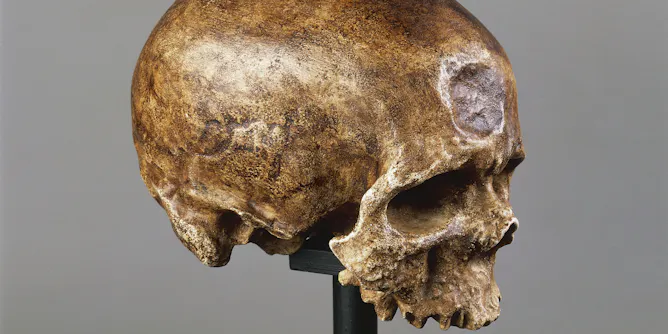
Our biggest evolutionary advantages are an ability to walk on two legs and our big brains.
Articles on Early humans
Displaying 21 - 40 of 53 articles
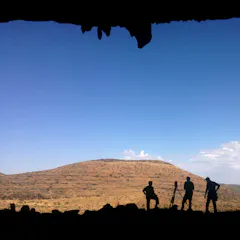
Researchers unearthed the 105,000-year-old artefacts from a spiritual site in southern Africa. Although far from the coast, the area is associated with stories of a great water snake.

Plus, new discoveries about early humans in Tanzania’s Olduvai Gorge. Listen to episode 5 of The Conversation Weekly podcast.
Research shows that when people feel insecure and anxious they become more concerned with identity values such as nationalism, status and success.
The ‘good’ side of our nature is much more deep-rooted than the ‘evil’ side.

History shows that behavioural factors play a major role in slowing and stopping disease spread.

300,000 years ago, there were lots of different species of human. Now it’s only us – and we’re probably the reason why.
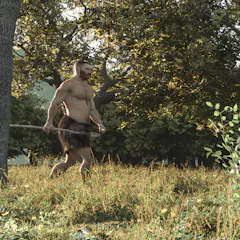
New research suggests humans spread to Europe at least 50,000 years earlier than previously thought.
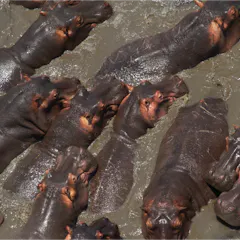
Long-standing assumption that humans killed large mammals 4.5m years ago has been debunked by researchers – but some experts still think humans played a part in the demise of biodiversity

Ancient stone tools found in what is now Algeria show early humans likely spread across Africa more rapidly than first thought.

Having movable eyebrows – and evolving beyond the Neanderthal ridge – may have played a crucial role in early human survival.
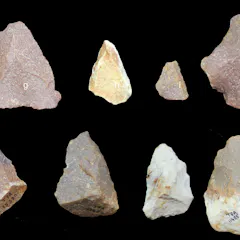
Modern humans could have left Africa shortly after evolving, making it to India in tens of thousands of years.

This new research offers compelling proof that the naysayers were right. “Mrs” Ples was actually a “Mr”.

New discoveries are changing archaeologists’ ideas about the origins of our own species and our migration out of Africa. This fossil pushes Homo sapiens’ African exodus date back by 50,000 years.

The story of where humans come from is growing as new evidence – and new methods of analysis – emerge all the time.

The evidence of a much earlier presence of humans in Indonesia was found more than 100 years ago. But only now has the age of the fossil teeth been accurately dated.
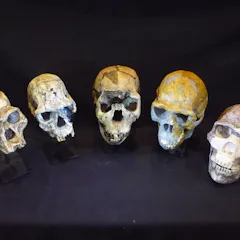
The brains of our ancestors grew larger and smarter thanks to an increase in the flow of blood to the brain
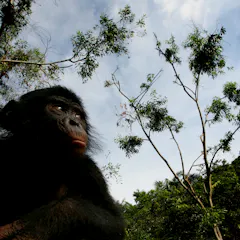
The two species mated 500,000 years ago, leaving a genetic mark to this day. This knowledge could help save them from extinction.
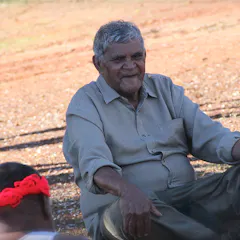
New research into how early humans spread across the world settles several long-running debates.

A new study suggests the first humans probably got to America from Siberia via the Pacific coast rather than through a corridor between two giant ice sheets, as previously thought.
Top contributors
-

Director, Australian Research Centre for Human Evolution, Griffith University
-
Professor of Archaeology and Biological Anthropology, School of Social Science, The University of Queensland
-
Honorary Associate Professor, UNSW
-
Professor, Palaeontology, Griffith University
-
CENIEH Director, Atapuerca Research Team and author of "Homo imperfectus" (Ed. Destino), Centro Nacional de Investigación sobre la Evolución Humana (CENIEH)
-
Senior Lecturer in Psychology, Leeds Beckett University
-
Professor of Quaternary Science, Royal Holloway, University of London
-
Professor, School of Natural Sciences, Macquarie University
-
Arqueólogo y profesor, Centro Nacional de Investigación sobre la Evolución Humana (CENIEH)
-
Associate Professor of Osteoarchaeology, Uppsala University
-
Associate Professor of Anthropology, Binghamton University, State University of New York
-
Curator of Plio-Pleistocene palaeotology, Ditsong Museums of South Africa
-
Senior Research Associate in Translational Genomics, University of Oxford
-
Postdoctoral Research Fellow in Biology, Stanford University
-
Honorary Research Associate, Evolutionary Studies Institute, University of the Witwatersrand