
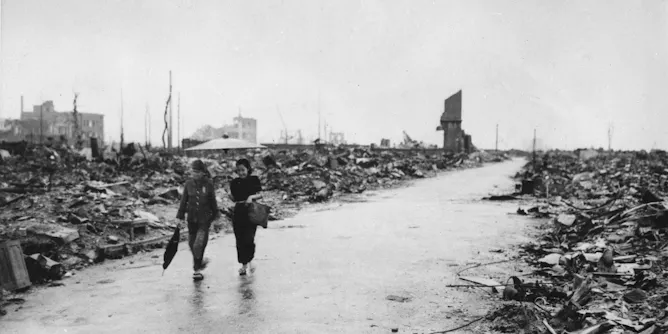
The Doomsday Clock is closer to midnight than at any point in its history.
Articles on Doomsday Clock
Displaying all articles

Complacency about the serious challenges the world is facing is not an option. But the idea that we are almost at the point of no return via the Doomsday Clock isn’t helpful.
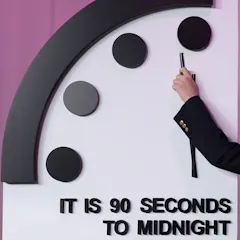
The Doomsday Clock is not a precise risk assessment, it’s a flawed but powerful metaphor for the catastrophic risk humanity faces
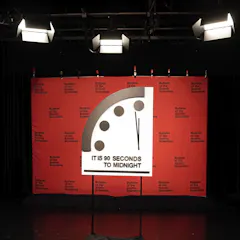
In 1945, nuclear scientists established the Doomsday Clock to warn against human-made threats. This week, the clock’s display has brought us the closest we have ever been to global disaster.
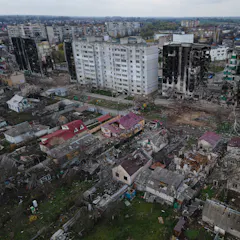
The world’s failure to contain the nuclear threat is frighteningly evident in the potential risk of war in Ukraine spinning out of control.

The Doomsday Clock has never before been as close to midnight as it is now. There is scant hope of it winding back on its 75th anniversary.

With the recent AUKUS agreement increasing tensions in the Indo-Pacific region, the time is right for nuclear-free New Zealand to take a lead.

A natural view of the world appealed to Albert Einstein.
As it moves to two minutes to midnight, the Doomsday Clock must be stopped.
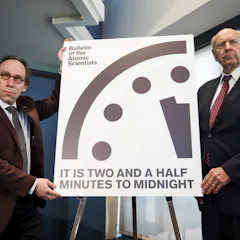
It’s two and a half minutes to midnight according to the Doomsday Clock. But what is the clock and why should we pay attention?
Dire government warnings and counter-terrorism raids in our suburbs paint a picture of the worst threat Western nations have ever faced. A little historical perspective is in order.
The second hand of the Doomsday Clock is now only three minutes to midnight. This is the closest to apocalypse we have come since 1984 – the coldest of Cold War years, just a year after Able Archer, the…
Top contributors
-

Professor of Law, University of Waikato
-
Lecturer in Positive Psychology, University of East London
-
Emeritus Professor, School of Environment and Science, Griffith University
-
Professor in International History, Flinders University
-
Lecturer, Aberystwyth University
-
Master’s student, Disaster and Emergency Management, York University, Canada
-
Visiting Fellow, School of Regulation and Global Governance, Australian National University
-
Associate Professor of Disaster and Emergency Management, York University, Canada
-
Professor of Molecular Biology and Genetics, University of Canterbury
-
Full Professor, Département d'anthropologie, Université Laval
-
Associate professor, Université Laval
-
James Martin Research Fellow, Future of Humanity Institute & Oxford Martin School, University of Oxford
-
Honorary Principal Fellow, School of Population and Global Health, The University of Melbourne