
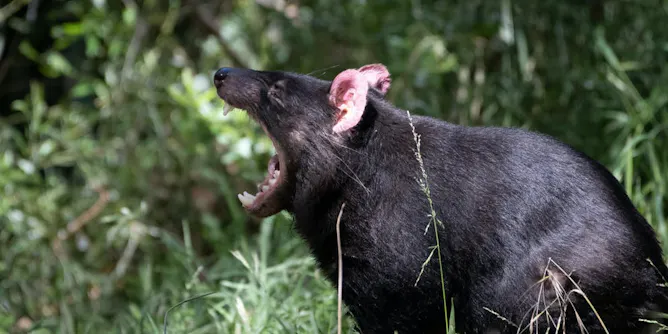
Tassie devils are notorious scavengers, eating everything from echidnas to stranded whales. Understanding how their teeth wear down can help us feed and protect captive populations.
Articles on Devil Facial Tumour Disease
Displaying all articles
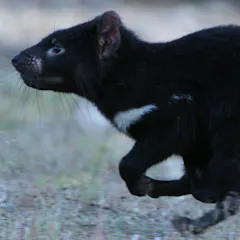
Ten years ago, we feared Tasmanian devils would be wiped out by a bizarre infectious facial cancer transmitted by biting. But new genetic analysis shows they are evolving to live with the disease.

The cutting-edge tools could greatly expand our understanding of different species’ immune systems, and also help humans prepare for future disease outbreaks.

Tasmanian Devils can be incredibly aggressive during mating season and their biting can have fatal consequences.

It’s the Tasmanian devils that enjoy the highest survival and breeding success who’re more likely to get the fatal facial tumour disease.
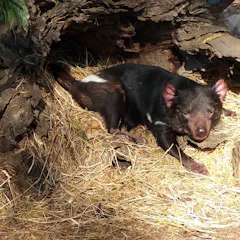
The facial tumour cells that threaten the Tasmanian devils may use a sort of molecular shield to protect them from the animal’s immune system.

Some animals bred in captivity often lack the skills needed to survive in the wild. But the Tasmanian devil is showing it’s a natural born killer.

New research suggests devils are evolving rapidly in response to their highly lethal transmissible cancer, and that the devils could save themselves.
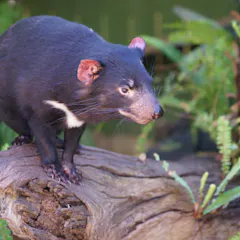
On Monday this week The Conversation published a story under the headline “What’s killing Tassie devils if it isn’t contagious cancer?” The article suggested evidence that the Tasmanian devil facial tumour…
A new discovery in the race to cure the Tasmanian devil facial tumour disease has given scientists hope of developing a vaccine…
Top contributors
-

Emeritus Professor, infectious disease ecology, Griffith University
-
Associate Professor in Zoology, University of Tasmania
-
Professional Research Fellow, University of Tasmania
-
Post Doctoral Research Fellow, Conservation Biology and Wildlife Management, University of Tasmania
-
Professor & Associate Director, School of Biological Sciences, Washington State University
-
Senior Research Fellow in Immunology, University of Tasmania
-
University of Idaho
-
University of Tasmania
-
Adjunct Research Associate, Monash University
-
Postdoctoral Associate, University of California, Berkeley
-
Professor, School of Biological Sciences, Monash University
-
Honorary Research Associate in BioSciences, The University of Melbourne
-
Professor Evolution & Ecology, UNSW
-
PhD Candidate in Zoology, University of Tasmania
-
Postdoctoral Research Fellow, Environmental Futures Research Institute, Griffith University