
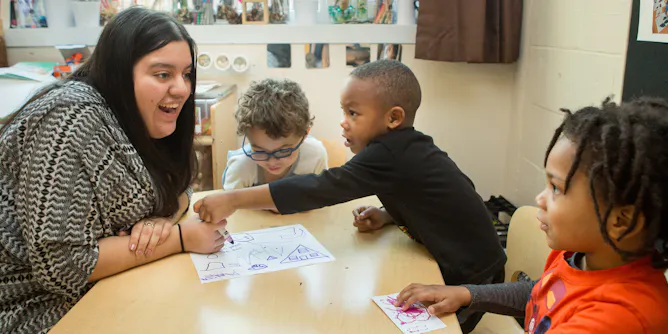
We need to ensure the best scientific research in play-based learning and early reading is leveraged, and teachers receive supports to meet children’s developmental and academic needs.
Articles on Curriculum
Displaying 21 - 40 of 168 articles

In Australia, the average age of first period is about 13. But about 12% of children get their period between the ages of eight and eleven.

Assessment is involved in many of the challenges facing higher education.

Examinations help a country measure if its system of education is teaching the skills and knowledge needed to meet development goals.

Two education researchers argue it is important we don’t let ‘curriculum wars’ distract us from the other issues hurting Australian schools and education.

There’s more to effective teaching than just implementing school policies.

Incorporating Akan folklore in the curriculum will promote quality and lifelong education in Ghana.

Parents need to directly hear from teachers and administrators via open houses or parent advisory councils to lift the fog of confusion and concern surrounding this change.

These programs may seem like a good idea. But they can threaten children’s engagement in learning and undermine teachers’ professional skills.

Teachers in Ontario elementary schools can learn from how teachers in China approach collaboration as subject area specialists, while Chinese teachers can learn about developing the whole child.

School systems need to wake up from ‘business as usual’ learning. Teachers can draw on terror management theory in their work on the front lines with students navigating the climate crisis.

Integrated computing enables teachers to incorporate basic programming skills into K-12 students’ regular math, science and language arts classes.

Simply setting aside time for collaboration doesn’t always lead to better outcomes for teachers or students. Effective collaboration requires skilful leadership and a common language.

The National Party’s new curriculum policy proposes reforms, when there are already several underway. What schools and teachers really need is more funding and less change.

Education can’t make up for inadequacies in other policies that continue to cause mass unemployment.

According to the Canadian Anti-Hate Network, far-right groups have been trying to stack school boards with candidates harbouring anti-equity ideologies.

Putting students at the centre of their learning is a powerful tool for decolonising the classroom.

An English professor takes a critical look at why today’s students are assigned the same books that were assigned decades ago – and why American school curricula are so difficult to change.

From the founding of the U.S., public schools were seen as a key way to develop an informed, active citizenry. Social studies educators struggle to achieve that goal today.

The US and the Soviet Union are both seen as responsible for the Cold War and presented as manipulating more vulnerable states.
Top contributors
-

Adjunct Professor, University of Technology Sydney
-
Senior Lecturer in Entrepreneurship, Consumer Studies and Technology Education, North-West University
-
Programme Leader, MA in Educational Assessment, UCL
-
Professor of Secondary Education, Faculty of Education, University of Alberta
-
Researcher in TESOL & Literacy, University of Notre Dame Australia
-
Associate Professor, Early Childhood Education, Queen's University, Ontario
-
Associate Professor, School of Education, Aarhus University
-
Campus and Secondary Principal at the International School of Geneva's La Grande Boissière, Research Associate at the University of Geneva's department of Education and Psychology, Université de Genève, Université de Genève
-
Emeritus Professor of Education, University of Derby
-
Professor, University of Cape Town
-
Emeritus professor, The University of Western Australia
-
Associate Professor in Sociology, Deakin University
-
Senior Lecturer in language education, University of Botswana
-
Course coordinator: Language in Humanities, University of Cape Town
-
Academic Development