
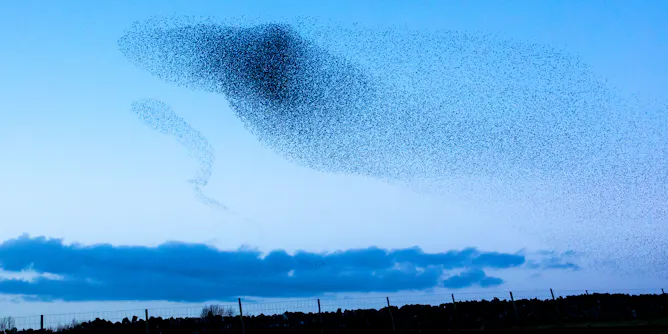
These coordinated movements of a flock of starlings follow no plan or leader. Scientists used to think the animals must communicate via ESP to create these fast-moving blobs.
Articles on Curious Kids US
Displaying 221 - 240 of 334 articles

Who are the Ukrainians and when were they part of the same empire as Russia? A scholar answers basic questions on war in Ukraine.

As long as you don’t tune out the world and protect your hearing, it’s hard to overdo it.

Hard and strong, or bendy and flexible? A cartilaginous skeleton provides advantages in the ocean, but wouldn’t stand up to life on land.

Poop comes in many shapes, sizes and textures. The kind that’s too runny might be the result of wayward germs, Crohn’s disease or lactose intolerance.

That brownish/yellowish gunk that comes out on your finger if you scratch deep inside your ear? It actually serves an important purpose in your body.

Blood plays a vital role in keeping us alive, from delivering oxygen to the body’s organs to fighting off infections.
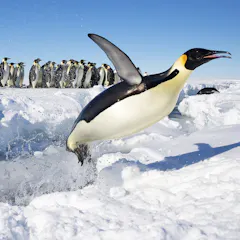
How did penguins end up with so few bones – and become lightning-fast swimmers?

Plants need light to feed themselves, so they grow in ways that help them collect as much of it as they can. Sometimes that’s straight up, but not always.

A healthy diet can include some candy. But if you eat too much, it can interfere with your appetite for the stuff your body actually needs.

Volcanoes might seem like nature’s incinerators, but using them to burn up trash would be dangerous and disrespectful to indigenous people who view them as sacred.

Extended periods of rain are most likely found in locations where mountains are near oceans.

The answer is more complicated than you might think. It has to do with how your body gets rid of old red blood cells.

The iconic image may have originated with a meat supplier named Samuel Wilson. Or not.

Video games are everywhere. So who was the first person to come up with the idea of playing a game on a computer screen?

Barns are practical buildings, designed to safeguard farm animals and equipment. Why are so many of them painted to stand out from the landscape?

The fastest things ever made by humans are spacecraft, and the fastest spacecraft reached 330,000 mph – only 0.05% the speed of light. But there are ways to go faster.

A fly does some of its digesting outside its body before it even eats any food.
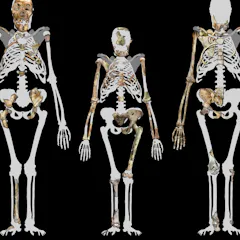
Walking has taken a very long time to develop, with evidence of bipedalism among early humans in Africa roughly 4.4 million years ago.

Even when the condition lasts a lifetime, there are behavioral treatments and prescription drugs that make it easier for people with attention-deficit hyperactivity disorder to thrive.
Top contributors
-

Distinguished Professor Emeritus of Anthropology, Binghamton University, State University of New York
-
Assistant Professor of Astronomy and Astrophysics, University of Maryland, Baltimore County
-
Professor of Astronomy, UMass Lowell
-
Professor of Biology, Clarkson University
-
Associate Professor of Veterinary Clinical Sciences, Oklahoma State University
-
University Distinguished Professor of Astronomy, University of Arizona
-
Doctoral Student in Biomedical Sciences, University of South Carolina
-
Lecturer in Geosciences, University of Montana
-
Assistant Professor of Gastroenterology and Hepatology, School of Medicine, University of Washington
-
Executive Dean of the College of Arts, Sciences & Education and Professor of Biological Sciences, Florida International University
-
Assistant Professor of Biological Anthropology, University of Tennessee
-
Professor and Chair of History Department, Colorado State University
-
Vice President of Academic Affairs and Dean of the College, Grinnell College
-
Associate Professor of Physics, University of Richmond
-
Associate Professor of Astronomy, Boise State University