

What is the gut-level appeal that saw Trump win two elections? One progressive researcher spent six years in America’s whitest, second-poorest district to find out.
Articles on Charlottesville attack
Displaying 1 - 20 of 34 articles
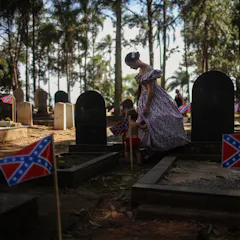
‘Ours is the only city in Brazil where the Confederate flag flies,’ said a city council member in Santa Bárbara d’Oeste. A new law there bans ‘symbols that promote racist and segregationist ideas.’

Listing a violent extremist group as ‘terrorist’ makes it illegal for any American to offer the organization financial support.
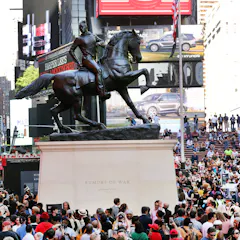
With a few notable exceptions, public monuments across the United States are overwhelmingly white and male. A movement is slowly growing to tell a more inclusive history of the American experience.
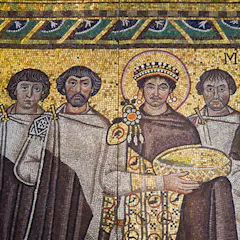
Long overlooked in the West, the Byzantine Empire has recently picked up interest among far-right and conspiracist circles. A historian of medieval culture explains what white supremacists get wrong.
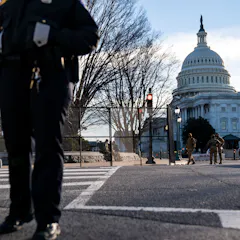
The FBI has long warned that white supremacist groups are seeking to infiltrate police, which makes the events of Jan. 6 all the more concerning.

Symbols of the Confederacy can be seen in Brazil, Ireland, Germany and beyond. While some people may not grasp their racist history, others clearly fly the ‘rebel flag’ to defend white supremacy.
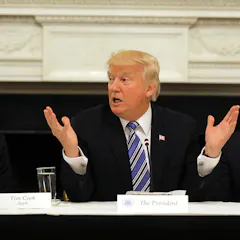
Despite a growing list of reasons why business leaders might oppose the president or his policies, more than two-thirds have remained steadfastly neutral.
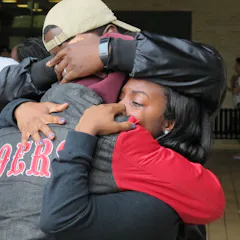
Like the death of Heather Heyer in Charlottesville, the murder of Richard Collins III was a symptom of violent extremism that should be treated accordingly.
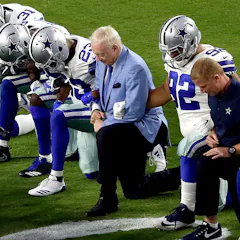
Team owners’ defense of their players ‘taking a knee’ during the national anthem shows the vital role business leaders play in political discourse – one championed by Citizens United.

Efforts to kick extremists off the internet can’t succeed and might even have the unintended side effect of bolstering support for radical groups.

Two websites, one taken offline, the other still active, raise hard questions about how prepared Americans are to deal with free speech about white supremacy, in both monuments and domain names.
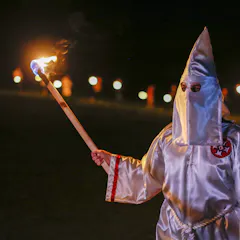
Far from the millions-strong mass movement of years gone by, today’s ‘Klan’ is really just a smattering of assorted local hate groups.
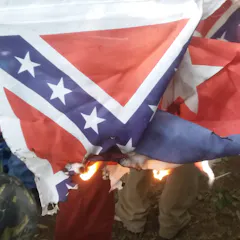
Doxing challenges traditional journalism. Its investigative role is circumvented by people disclosing information online quickly, and often inaccurately.
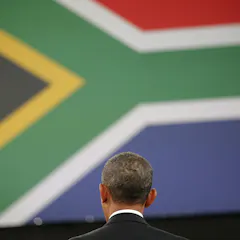
Barack Obama may have chosen Mandela’s words for his tweet precisely because they offered some distance from the political space in the US.

In defending white nationalists in Charlottesville, Donald Trump took aim at the founding fathers.
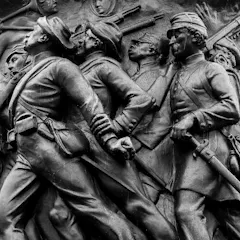
Displaying Confederate statues in a carefully curated museum would help end a toxic debate about the difference between remembering and venerating.

There’s talk of a new ‘Christian crusade’ – and it’s highly dangerous.

What WWII-era African-American protests reveal about the historical relationship between Nazism and white supremacy in the United States.
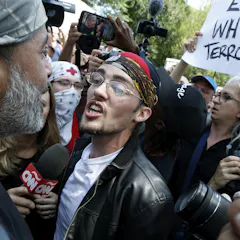
We have an ethical obligation to stand against fascists and racists in a way that doesn’t help them.
Top contributors
-

Director of Security Studies and Professor of Criminology and Justice Studies, UMass Lowell
-
Visiting Assistant Professor of Geography, Macalester College
-
Associate Professor, Department of Educational Studies, University of British Columbia
-
Associate Professor, Media, Swinburne University of Technology
-
Adjunct Professor at the School for Conflict Analysis and Resolution, George Mason University
-
Commissioning Editor, Health + Medicine and Host of Strange Health podcast, The Conversation
-
Senior Lecturer in Modern American History, Nottingham Trent University
-
Instructor, Division of Academic General Pediatrics, Mary Ann & J. Milburn Smith Child Health Research Program; Ann & Robert H. Lurie Children's Hospital of Chicago; Department of Pediatrics, Northwestern University Feinberg School of Medicine, Northwestern University
-
Co-Director, Institute for Genocide and Mass Atrocity Prevention, Professor, Department of Philosophy, Binghamton University, State University of New York
-
Associate professor US History, University of Exeter
-
Senior lecturer, School of Governance, University of the Witwatersrand
-
Co-Director, Institute for Genocide and Mass Atrocity Prevention, and Professor of Public Administration, Binghamton University, State University of New York
-
Professor of History, University of Washington
-
Senior Lecturer, UniSA Creative, Adelaide University
-
British Academy Global Professor, Queen's University, Ontario