
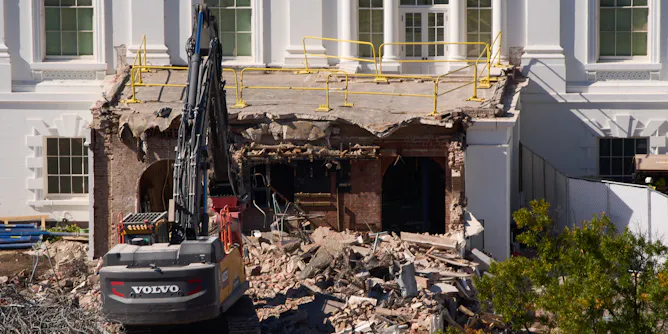
President Donald Trump is trying to prescribe the style and content of many federal sites to highlight his own authority and promote a particular view of America.
Articles on Confederate statues
Displaying 1 - 20 of 28 articles
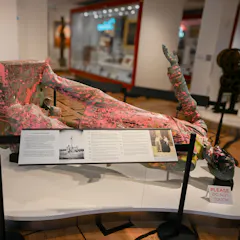
Protesters toppled and damaged a statue of Jefferson Davis in Richmond, Virginia, in 2020. It is now displayed at a museum just as they left it: prone and paint-splattered, with a toilet-paper noose.

A memorial to Coretta Scott and Martin Luther King Jr. has received stinging criticisms, but time will tell whether ‘The Embrace’ will endure as a cherished work of public art.
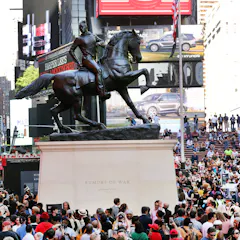
With a few notable exceptions, public monuments across the United States are overwhelmingly white and male. A movement is slowly growing to tell a more inclusive history of the American experience.
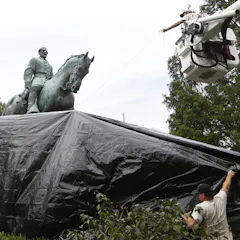
Once stripped of their symbolic power, problem monuments offer what educators call ‘teachable moments,’ helping people assess society’s current values and compare them with what mattered in the past.
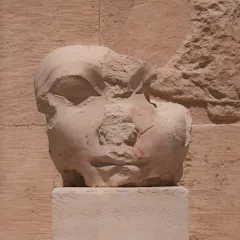
As US protesters deface monuments of once revered leaders, they are drawing from an ancient tradition used by both marginalized people and those in power.
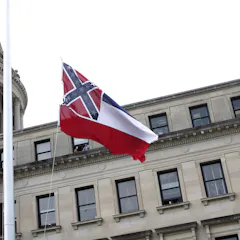
Public officials and individual citizens alike are more likely to oppose the presence of Confederate symbols when informed it may be bad for local business.

As momentum builds to remove statutes that pay homage to Confederates and others who sought to uphold white supremacy, a historian explores questions about what should be erected in their place.

Protests of Confederate flags and monuments have grown since 2015, but resistance is not new. African Americans have been protesting against Confederate monuments since they were erected.
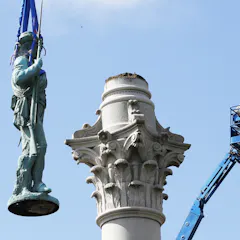
Demands to remove, or preserve, the statues polarize communities, rather than building a shared future.

Symbols of the Confederacy can be seen in Brazil, Ireland, Germany and beyond. While some people may not grasp their racist history, others clearly fly the ‘rebel flag’ to defend white supremacy.
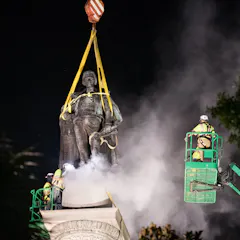
Despite his defense of slavery, the former vice president and US senator from South Carolina has been honored with statues and streets, schools and counties. That’s finally changing.
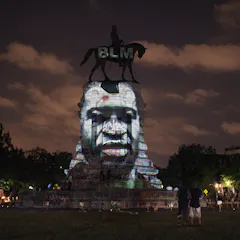
A Richmond court says the city cannot remove its controversial Robert E. Lee sculpture because an 1890 land deed gave the Confederate monument ‘to the people’ of Virginia, not its government.

On June 19, a court will decide whether Virginia must obey a 1890 deed that gave the state a plot of prime Richmond land as long as it would ‘faithfully guard’ the Robert E. Lee statue erected there.

The vandalism of colonial statues is an expression of political protest against the celebration of settler colonialism in Canada.

Take a good look at those old Christmas ornaments before hanging them on the tree – you may find it’s time to retire some family keepsakes.
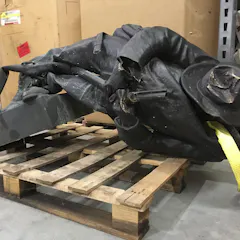
Where do old Confederate statues go when they die? The former Soviet bloc countries could teach the US something about dealing with monuments from a painful past.
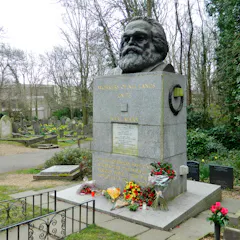
Statues to divisive figures are increasingly becoming the target of protest and vandalism.
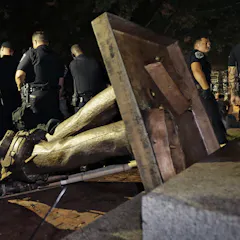
Toppling statues devoted to Confederate soldiers may be a joyous moment for protesters who fight white supremacy, but after the statues fall, structural racism remains, a scholar on slavery argues.

Many cities are removing their Confederate statues. But pioneer monuments represent a racist past, too. There are at least 200 of them, and their future is now being debated.
Top contributors
-

Professor of Higher Education and Director, Museum of Education, University of South Carolina
-
Professor of Law, University of Richmond
-
Visiting Assistant Professor of Geography, Macalester College
-
Professor of History, Binghamton University, State University of New York
-
Professor of History, University of North Dakota
-
Associate Research Fellow, Heritage Destruction Specialist, The University of Melbourne
-
Ruth Coulter Heede Professor of Art History, Case Western Reserve University
-
Professor of History and Director of the Undergraduate Program in Judaic Studies, Fairfield University
-
Assistant Professor of US History, Durham University
-
Professor of American Politics, George Mason University
-
Derek H. Alderman is a Friend of The Conversation.
Chancellor's Professor of Geography, University of Tennessee
-
Assistant Professor of Anthropology, University of Colorado Boulder
-
Professor of Political Science and Public Policy; Director, Democracy and Fair Elections Lab, USC Dornsife College of Letters, Arts and Sciences
-
Assistant Professor of Political Science, North Carolina State University
-
Associate Provost of Academic Affairs | Professor of Rhetoric & Communication Studies, University of Richmond