
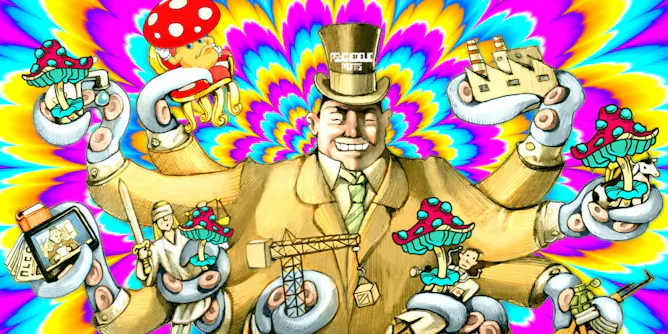
Psychedelics are marketed as a way for the general population to extract more work out of their already overworked lives, and to be happy about it in the process.
Articles on Capitalism
Displaying 21 - 40 of 290 articles

More information doesn’t necessarily result in better predictions of stock prices.

Neoliberalism encourages us to see ourselves as isolated individuals, responsible for our own success or failure.

Corporations are ‘legal persons’ under the law. But their ability to be ‘owned’ by shareholders embeds a system of exploitation at the heart of capitalism.
In the early 20th century, peasant movements combined a hatred of cities with imaginative blueprints for social and economic reform.

The dread that AI evokes seems a distraction from the more disquieting scrutiny of humanity’s own dark nature.

Ulrike Herrmann argues we no longer have the time to wait for technological breakthroughs that might solve the climate crisis.

The US economy has always been a mix of government regulation and market forces. The balance between those has shifted over time, but never has one side or the other been substantively removed.

Development agencies should be careful about creating tensions between existing cultural norms and new concepts and behaviours they are introducing.

How oil changed capitalism.

In the 1600s the Netherlands established one of the world’s first art markets – but it couldn’t have happened without the economic boom spurred by the slave trade.

In the Peruvian Amazonian city of Iquitos, the first wave of COVID-19 brought unprecedented chaos and a black market in oxygen and mass graves.

The death of capitalism has been greatly exaggerated.

In contrast to other critiques of capitalism that tend to highlight the players behind the scenes, ‘Squid Game’ Season 2 unearths why people play along with the system in the first place.

Climate change affects women’s health, livelihoods and security disproportionately because of gender inequality and patriarchal structures.

Our response to the housing crisis is conditioned by the choices we made when faced with the industrial city’s workers’ housing crisis. We must accept this heritage and question it.

Unless the economic benefits resulting from having the government of national unity become socially inclusive, it might well collapse.

Communism, Marxism and socialism are all different economic and political ideas. As concepts, they all seek to move toward greater economic equality and public participation in democracy.

Guinness adverts show how African men’s search for validation can enrich western corporations.
A new book argues that climate change rose from imperialism and capitalism.
Top contributors
-

Professor of Business and Society, University of Technology Sydney
-
Adjunct Professor, Australia-China Relations Institute, University of Technology Sydney
-
Academic Director, School for International Training, The University of Melbourne
-
Senior lecturer, University of the Witwatersrand
-
Professor of Organisation Studies, University of Bristol
-
Associate Professor, English and Theatre Studies, University of Guelph
-
Professor of Organisational Studies, University of Sydney
-
Director, Melbourne Sustainable Society Institute, The University of Melbourne
-
Professor of Economics, Manchester Metropolitan University
-
Professor of Comparative Political Science and Democracy Research at the Humboldt University Berlin; Associate of the Sydney Democracy Network, University of Sydney; Director of Research Unit Democracy: Structures, Performance, Challenges, WZB Berlin Social Science Center.
-
Research Fellow, University of Manchester
-
Senior Research Fellow in Nonprofit Organizations, UMass Amherst
-
Research Professor, Hertfordshire Business School, University of Hertfordshire
-
Professor of Business and Sustainable Development, University of Edinburgh
-
Professor of Innovation & Knowledge Exchange, University of Oxford