
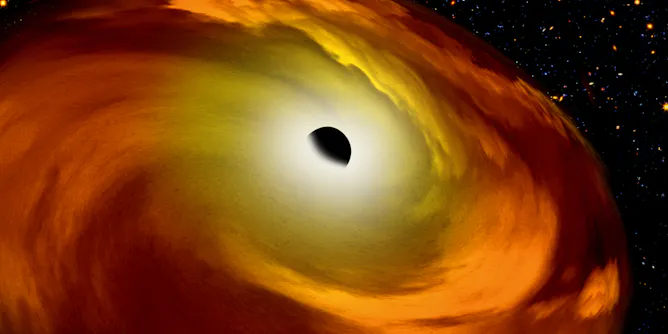
Some stars turn into black holes at the end of their lifespans, once they stop burning the fuel in their cores.
Articles on Black hole
Displaying 1 - 20 of 33 articles
An astronomer explains why artificial black holes are pure science fiction – at least for now.
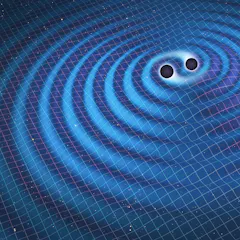
A decade after the first discovery, scientists have used these waves to find a unique merger, a massive binary system and a crystal-clear gravitational wave signal.
New theory makes testable predictions.
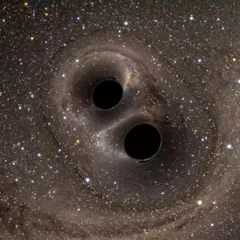
Most objects in the universe have been around for way longer than modern astronomy – digging into historical records can help scientists shed light on a cosmic mystery.
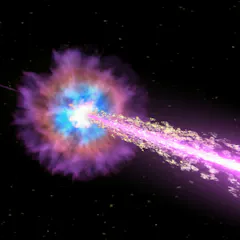
Analysis of two major cosmic blasts deepens the mystery of where the universe’s ‘heavy’ elements come from.
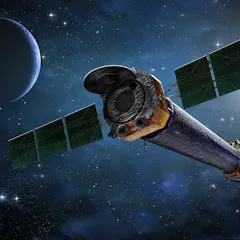
2024 marks 25 years since NASA’s Chandra X-ray Observatory started detecting X-rays from energetic astronomical events.

Tau neutrinos are notoriously difficult to spot in detectors like IceCube. But researchers have managed to isolate 7 candidates.
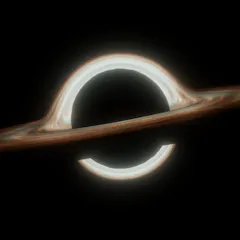
The extreme object could tell us more about the environment around black holes.
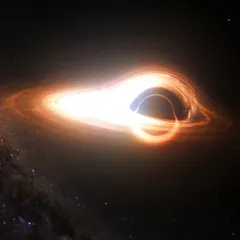
While we can’t see inside a black hole, we can spot the intensely bright glowing disc that surrounds one. Now, we might better understand why these discs appear to ‘twinkle’.
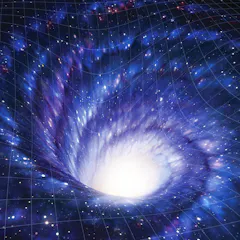
An astrophysicist explains what wormholes are and how these theoretical space-time tunnels have popped up in the solutions to a set of decadesold equations.

Sagittarius A* lies in the southern sky, passing directly above South Africa.

The aftermath of a black hole colliding with a neutron star has been recorded on Earth.

The black hole is part of a binary star system within our Milky Way galaxy. It orbits a colossal supergiant companion star.
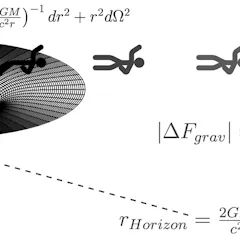
If you are a sci-fi junkie you’ve probably wondered what would happen if you were unlucky enough to fall into a black hole. How well you’d fare all depends on the type of black hole.
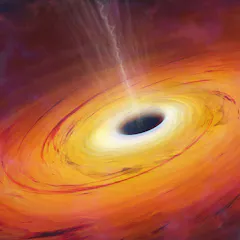
The 2020 Nobel Prize in physics was awarded to three scientists – an Englishman, an American and a German – for breakthroughs in understanding the most mysterious objects in the universe: black holes.

Twisted sound beams suggest an advanced civilisation may be able to harness immense amounts of power from a black hole.

Radio flare may be the result of a giant star orbiting some unusual object – a combination we have never seen before.
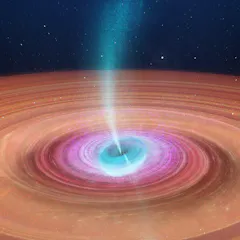
A spinning black hole is pumping vast amounts of energy back into the surrounding universe, but something is causing the jets that transport that energy to wobble very rapidly.
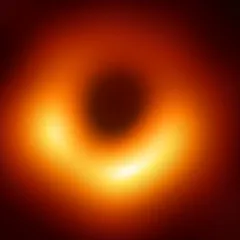
Astronomers say they have “seen what we thought was unseeable” in releasing the first image of a supermassive black hole. So how did we get to this historic observation?
Top contributors
-

Senior Lecturer and ARC Future Fellow, Monash University
-
Professor of Astrophysics, University of Sydney
-
Professor, Curtin Institute of Radio Astronomy, Curtin University
-
Professor of Astronomy, Swinburne University of Technology
-
Senior Curator (Astronomy), Museums Victoria Research Institute; The University of Melbourne
-
ARC Future Fellow, Australian National University
-
Associate Professor, Adelaide University
-
Professor of Extragalactic Astronomy, Head of the Astrophysics Group, University of Bath
-
Associate Professor, The University of Queensland
-
Professor of Astrophysics, The University of Queensland
-
Senior Research Scientist, UCL
-
Postdoctoral research fellow in Gravitational Wave Astrophysics, Monash University
-
Professor, Monash University
-
Professor of Physics and Astronomy & Professor of Microbiology and Molecular Genetics, Michigan State University
-
Research fellow, The University of Western Australia