
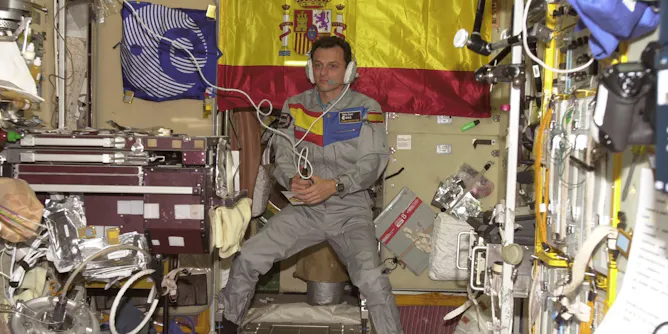
On the 50th anniversary of man’s historic moon landing, Pedro Duque remembers how every child wanted to be an astronaut in 1969.
Articles on Astronauts
Displaying 101 - 120 of 150 articles
It seems being in space could make us more reluctant to take risks.
If SpaceX wants to take humans to the International Space Station and beyond it must pull off a safe landing of its Dragon capsule.
Here’s what NASA scientists discovered when an astronaut went into space and his twin remained on Earth.

New experiment on the International Space Station could help us tackle muscle loss in astronauts.
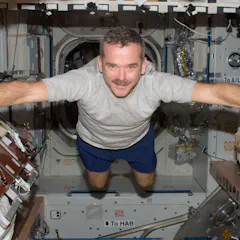
New research has uncovered exactly what happens to the brain when astronauts are in space.
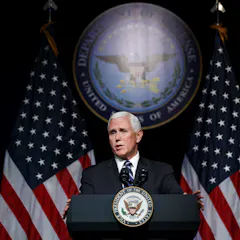
Could Canadian technology play a part in the newly announced U.S. Space Force? A team at McMaster University has developed an instrument that could keep Space Force troops safe from radiation.
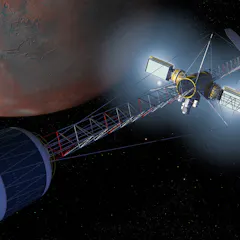
It is possible to split water into oxygen and hydrogen gas in zero gravity using sunlight, shows new study.
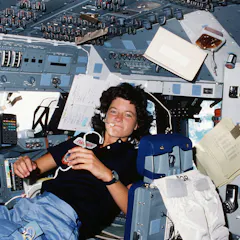
35 years ago Sally Ride became the first American woman in space. But rather than focus on her own extraordinary achievements, her passion became boosting the number of girls pursuing STEM. Another pioneering astronaut remembers her friend and colleague.
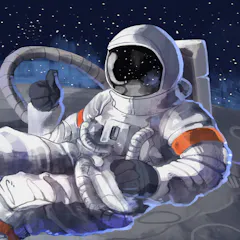
Out there in space there is no air. If you took your helmet off, all the air you need to breathe would whoosh out.
With any type of human exploration, there are risks as we push boundaries, and there are inevitably mishaps and fatalities as a result. Space tourism is no exception.
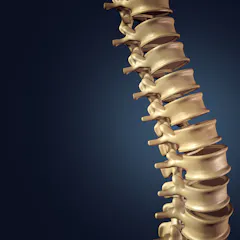
The human spine can withstand heavy lifting, according to the latest research.
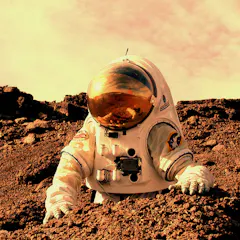
Cosmic radiation is much higher today than it was during the Apollo era.
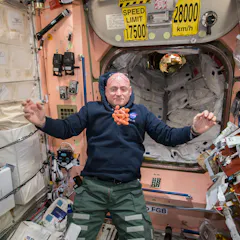
It’s been reported that astronaut Scott Kelly no longer has the same DNA as his twin brother after spending a year in space.
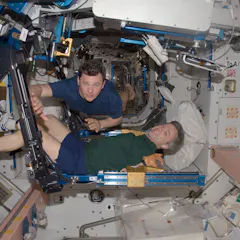
The students of class 3F at Ferny Grove State School want to know how they get oxygen into the International Space Station.

The students of class 3E, Ferny Grove State School, want to know if astronauts get space sick when travelling to the International Space Station.

Astronauts traveling to Mars and beyond would face serious psychological challenges. A well-designed media program – based on an old-fashioned schedule – might help make life at least a bit easier.
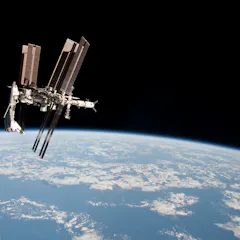
Sperm that’s been to space is good enough to get mice pregnant – and give birth to healthy offspring.
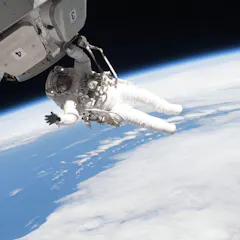
Every moment of life on our planet has had the force of gravity in the background. But the prospect of long-distance space travel means it’s time to figure out what happens to our biology in its absence.
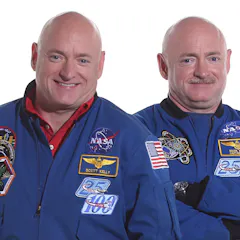
A twin experiment in space can help us prevent diseases on Earth.
Top contributors
-

Postdoctoral research associate, University of Oxford
-
Senior Lecturer in Physics, Nottingham Trent University
-
Professor of Aerospace Medicine and Rehabilitation, Northumbria University, Newcastle
-
Professor of Planetary and Space Sciences, The Open University
-
Associate Professor in Archaeology and Space Studies, Flinders University
-
Professor, School of Engineering and Technology, CQUniversity Australia
-
Senior Lecturer, Department of Psychological Sciences, Birkbeck, University of London
-
Kevin Orrman-Rossiter is a Friend of The Conversation.
Sterrenkenner, History & Philosophy of Science, The University of Melbourne
-
Professor of Strategy and Security Studies, Air University
-
Professor in Earth and Planetary Science, Western University
-
Chercheur affilié à l'Observatoire international sur les impacts sociétaux de l’intelligence artificielle et du numérique (OBVIA), Université Laval
-
Lecturer in Astronomy, Nottingham Trent University
-
Research Fellow/Reader in Planetary Physics, Lancaster University
-
Associate Professor of Sport Science and Human Performance and Strategic Lead for Knowledge Exchange, Faculty of Sport, Health and Social Sciences, Southampton Solent University
-
Visiting Researcher at the Centre of Human and Aerospace Physiological Sciences, King's College London