
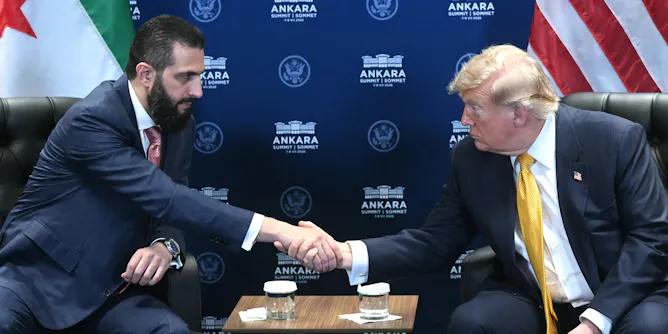
Syria was among the first nations to be added to the State Department’s proscribed list. It has been removed under the rule of a former al-Qaida-affiliated militant.
Articles on Ahmed al-Sharaa
Displaying all articles

Despite risks, Kurds in Syria have the best chance in a generation to protect their national rights. Their success may hinge on the international community.
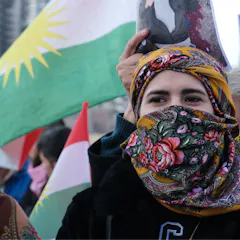
After the fall of Bashar al-Assad, minority groups in Syria have been targeted with violence. The US and other regional powers have largely stayed silent.

The attack in Palmyra reveals deep vulnerabilities in Syria’s security architecture, highlighting the challenges of reforming a fragmented state after conflict.
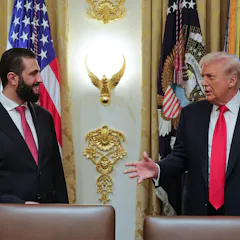
Ahmed al-Sharaa has become the first Syrian leader in history to be invited to the White House.

Trump’s world order: praising Syrian President Ahmed al-Sharaa as an ‘attractive guy’, while disparaging the first Muslim mayor of New York as a ‘lunatic communist’.

Women have won just six seats so far in the new 210-member parliament. This is not surprising considering how few were permitted to vote or stand as candidates.
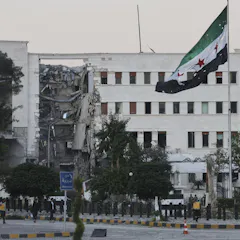
A US-backed diplomatic push is trying to end months of Israeli attacks on Syria with a bilateral security pact. But concluding an agreement may prove a tall order.

Syria’s economy has been battered by war – the coming years will be decisive.

Syria’s foreign ministry says a number of soldiers and civilians have been killed by coordinated Israeli drone attacks and airstrikes near the two countries’ border.

Trump skirted the ongoing tragedy in Gaza, bypassed Israel and offered no new initiatives on Iran’s nuclear program.

The violence in Syria in recent days has shown how difficult it will be to unite a fractured country with deeply held grievances.
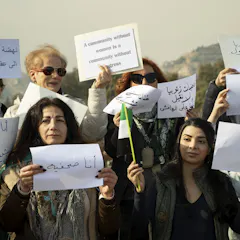
The new leadership appears to have ultra-conservative ideas about women’s role in society.

Ahmed al-Sharaa’s plans for Syria risk repeating past rebel mistakes. Negotiated, inclusive constitutional reform is key to Syrian stability and avoiding renewed conflict.
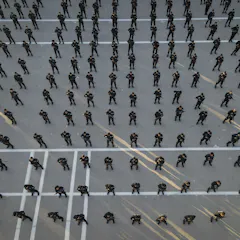
The fall of the Assad regime opens the door for a new, inclusive, democratic, Syrian-led and Syrian-owned path, but it remains a path full of pitfalls and challenges.
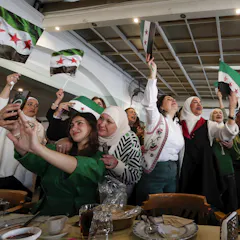
The international community should focus on empowering Syria’s local civil society groups and advocating for women’s rights to ensure a more inclusive society.
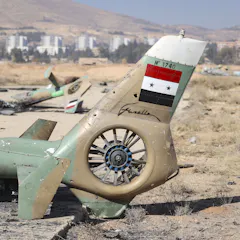
The country is deeply divided along religious and ethnic lines, which makes continuing violence one likely scenario.
Top contributors
-

Research Fellow, Middle East Studies, Deakin University
-
Lecturer in Politics and International Relations, Teesside University
-
Associate Professor, Faculty of Law, Centre for Human Rights and Legal Pluralism, McGill University
-
Senior Research Fellow, Institute for Global Prosperity (IGP), UCL
-
Professor of Political Science, Brandon University
-
Senior Teaching and Research Fellow, University of Passau
-
Lecturer in Political Science, University of British Columbia
-
Senior Researcher in International Human Rights Law & Humanitarian Law at Essex Law School and Human Rights Centre, University of Essex
-
Professor, Department of Government, University of Essex and Non-Resident Fellow at Center for Middle Eastern Studies at the University of Arizona, University of Essex
-
Director, Middle East Studies Forum (MESF), Deakin University
-
Associate Professor in Finance, University of Sussex
-
PhD Candidate in History, University of California, Los Angeles
-
Director of Dickinson Program in New Zealand & Associate Professor of Politics at the University of Otago, Dickinson College
-
Senior Lecturer in Politics and International Relations, Monash University
-
Lecturer in Law, Monash University