
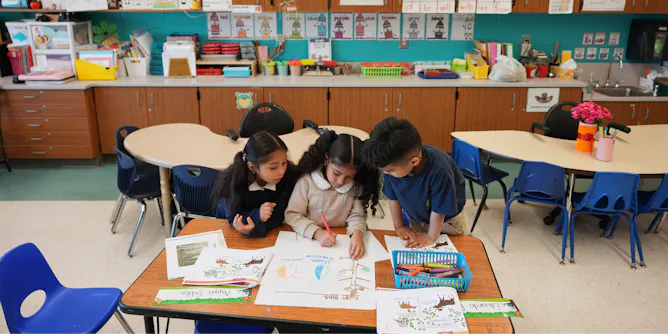
Inflexible meeting times, transportation and childcare challenges can limit parents or caregivers from getting involved in their children’s education.
Articles on Academic achievement
Displaying 1 - 20 of 32 articles

Revenues for Michigan’s districts have failed to keep pace with inflation and the evolving needs of today’s students.
It is common for parents to worry about raising a child to be multilingual. They may wonder, am I harming my child’s English if I speak another language at home?
The practice of holding kids back a grade is becoming a more popular solution to address low achievement scores. But research suggests it often does more harm than good for students.

Taking the stress and uncertainty out of going back to school can ease the process, a veteran counselor explains.

In our new research we looked at what impact breakfast has on students’ motivation to learn and their academic achievement.
Research shows students who are confident about their ability to succeed tend to be more academically successful. A new Australian study shows how to boost student confidence.
A key way to support mental health and well-being is to support strong reading instruction especially early in children’s education.
Two education researchers reviewed the evidence on year-round school. Here is what they found.
Kindergartners who are relatively younger than their classroom peers are at risk for doing less well in school. A clinical psychologist explains how to reduce those problems.

In the first study of its kind, researchers found medication alone has no detectable impact on how much children with ADHD learn in the classroom.

Grades don’t actually measure learning, and they can increase students’ stress and decrease their motivation. A college professor explains an alternative to grading students’ work.

Researchers have spent decades studying how demographics affect American students’ opportunities and performance, but many questions remain about religion and school.
For a learner to be the best and to win awards, their peers must lose. This expense is far too great to ignore in a country fraught with inequalities.

Despite a growth in revenue from wind farms, many rural school districts are being nudged by policy and law to spend the money on buildings and not instruction.
The NSW curriculum review recommends students be assigned tasks based on their ability, rather than their age. This approach recognises the progress individuals make over the course of a year.

The 2020 Prime Minister’s Prizes for Science have recognised momentous achievements in astrophysics, sustainability innovation, epigenetics and primary and secondary teaching excellence.
The disruption to K-12 education caused by the coronavirus pandemic may have major academic consequences, especially for low-income children.

A study found that students’ experiences of parents’ psychological control predicted higher fear of failure and worse adjustment to their university studies.

Previous research suggests teacher quality accounts for up to 30% of the reason some students get better marks than others. Our research on twin pairs turns that on its head.
Top contributors
-

Scientia Professor and Professor of Educational Psychology, UNSW
-
Professor of Public Policy, Education, and Economics and Director of the NYU Institute for Education and Social Policy, New York University
-
Administrator, Acceleration Institute and Research, University of Iowa
-
Clinical Associate Professor of Special Education, Wheelock College of Education and Human Development, Boston University
-
Assistant Professor of Pediatrics, The University of Texas Medical Branch
-
Clinical Professor of American and New England Studies, Boston University
-
Professor of Developmental Psychology, Leuphana University
-
University Professor of Pscyhology, George Mason University
-
Assistant Director of Education and Social Policy, New York University
-
Associate Professor of Educational Economics, New York University
-
Associate Professor of Education Policy and Psychology and 21st Century Chair, University of Arkansas
-
Associate Professor of Human Development and Family Studies, Michigan State University
-
Professor of Education, University of Iowa
-
Consultant, Australian Council for Educational Research
-
Professor of Curriculum and Instruction in Early Childhood Education, The University of Texas at Austin