
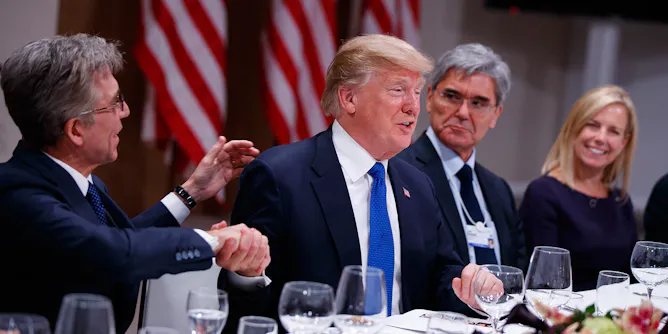
The billionaires, business leaders and other elites who gathered in Davos praised the president’s policies, yet research on the politics of economic growth suggests it’s too soon to celebrate.
Articles on World Economic Forum
Displaying 21 - 40 of 69 articles
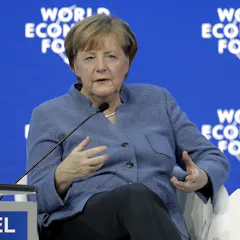
Will young Germans remember their history – and will older German embrace the digital future?
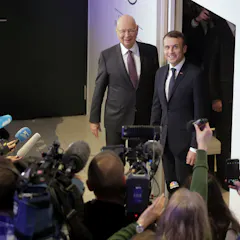
French companies will no longer be ‘forbidden to fail’ and ‘forbidden to succeed,’ the French president tells the World Economic Forum.

It will be the private remarks between senior Australian business leaders and foreign investors at Davos that will likely be the most consequential for the Australian economy in the coming few years.

The movement against globalisation has shifted from developing to developed countries.

China’s actions in the South China Sea are getting scant attention at Davos. But if the Chinese set a precedent for other rogue nations, there will be a profound impact on global free trade.
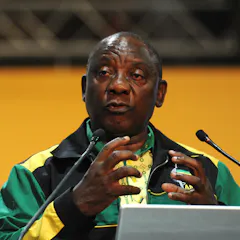
The shake up at South Africa’s power utility, Eskom, sends a good signal about where Cyril Ramaphosa is taking the country.
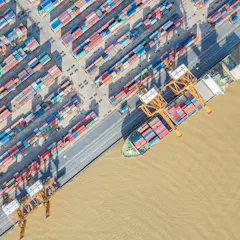
Crunching the numbers on 14 years of trading shows one of the assumptions about global markets is looking fragile.

China’s bid for an infrastructure blitz to drive overland trade through to Europe will end up being overshadowed.

The countries doing innovative deals with trading partners have one key difference with a post-Brexit UK.
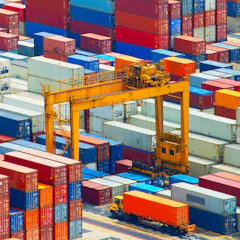
Major nations make labour rights a key part of trade deals. But what happens next?

The need to connect African markets to aid development will once again be discussed at the World Economic Forum. The debate needs to move beyond the usual rhetoric.

We get angry about pay disparities, but the complex nature of executive salaries makes it hard to know where to start.

The soaring cost of housing has helped make capital ownership more profitable than work.

Redressing the balance can start from the bottom up.

Wealth inequality is no 21st-century phenomenon. But it was decisively shaped by public policy during the last 100 years as economies emerged from war and redesigned the structures for life.
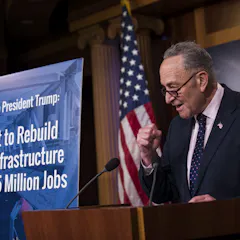
The trillions of dollars spent on infrastructure demands democratic transparency and accountability. This applies to both the investment and to the effects on cities, societies and the environment.

New technologies are developing with exponential velocity, breadth and depth. Their systemic impact is likely to be profound.
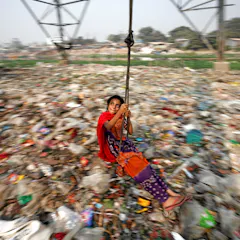
Bangladesh is a global poster child when it comes to improving women’s status in the developing and the Muslim worlds. But a recent amendment to the country’s marriage law threatens its progress.

We’re living in a time of rapid transformation in terms of what’s required for a country’s workforce. Design thinking is one way to prepare graduates for these changing times.
Top contributors
-

Professor of Innovation & Knowledge Exchange, University of Oxford
-
Professor of Advanced Technology Transitions, Arizona State University
-
Professor of Ethics and Business Law, University of St. Thomas
-
Professor of Economics, USC Dornsife College of Letters, Arts and Sciences
-
Professor of Political Economy, Lancaster University
-
Associate Professor of Political Science, Georgia State University
-
Professor of History, University of Michigan
-
Professor of Political Science, Athabasca University
-
Doctoral Researcher in Economic History, Lund University
-
Professor of History and Gender, Women's, and Sexuality Studies, University of Iowa
-
Director of the Skoll Centre for Social Entrepreneurship, University of Oxford
-
Tony Walker AM is a Friend of The Conversation.
Director, La Trobe University
-
Chair & Professor of International Business, University of Manchester
-
Design Thinking Programme Manager, University of Cape Town
-
Professor, Information Security Group, Royal Holloway, University of London