
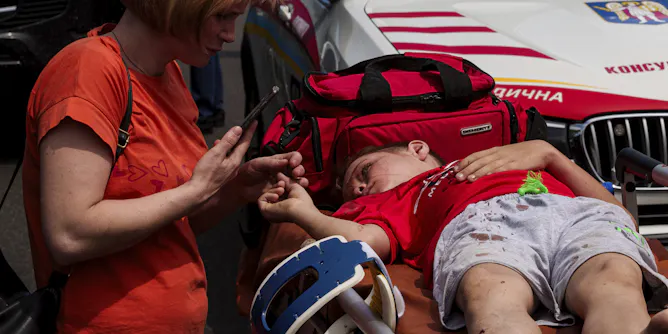
Russia’s recent attack on a children’s hospital is likely the sign of declining military performance.
Articles on War propaganda
Displaying all articles

The International Olympic Committee has ruled politically-neutral individual athletes are eligible, but some nations aren’t happy about it.
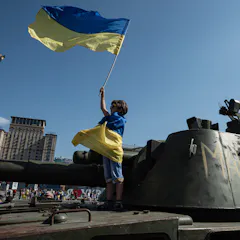
Since Russia first invaded Ukraine in 2014, more and more Ukrainians say that they feel pride for their country.

Libraries play a crucial role in preserving texts, even controversial ones. They are responsible for teaching people how to evaluate the credibility and validity of information.

Ukraine is partnering with an advertising company to produce an innovative nation branding campaign during a war. The campaign could have influence beyond how Ukraine and Russia conduct this war.
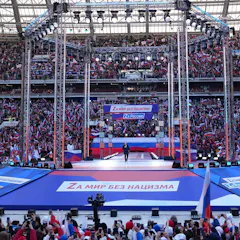
For hundreds of years, Russia has elevated its political leaders as figureheads. That’s part of what makes its propaganda so convincing.

Deepfakes — manipulated images of people — can be difficult to distinguish from the real thing, and this has terrifying consequences for democracy.
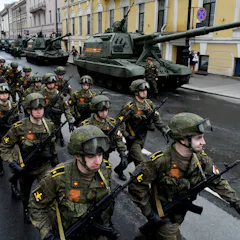
Western officials say that Russia may officially declare war on Ukraine on May 9. An international relations expert explains why this day is significant, and why a war declaration would matter.

Poland has an opportunity to emerge from this refugee crisis a more united, more accepting and economically strong society, but first they need to have tough conversations about immigration.

Cyberattacks can be devastating, just not on the battlefield, according to researchers who looked at 10 years of armed conflicts around the world.
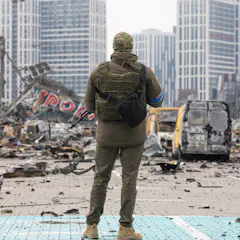
There are a few warning signs that genocide is happening. In the Russian war on Ukraine, all of those are present.
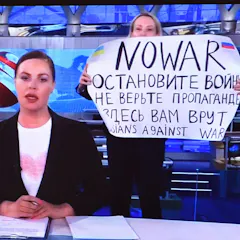
Russia is cracking down on freedom of speech and media. But other factors, like outside online information, could make it difficult to control war propaganda - and block out other information.
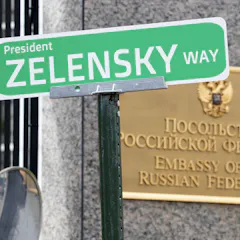
Propaganda is a key weapon of war and, in this regard at least, Ukraine is winning.
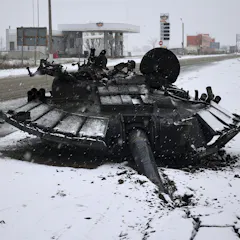
Footage claiming to document the situation in Ukraine may not necessarily be genuine. Here’s how to treat viral footage with the right level of scepticism before sharing it on social media.
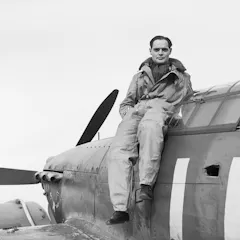
As it faced imminent Nazi invasion, Britain needed heroes. The RAF provided one ready made: a fighter pilot with no legs.
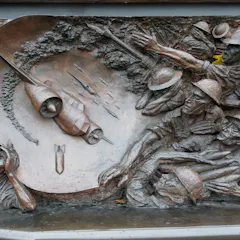
US correspondents in Britain played a big part in convincing the American public to support the British war effort.

The Portuguese colonisers were not the only ones who could use radio for control. A new book tells how popular radio broadcasts from Angola’s liberation fighters were used as weapons in the struggle.
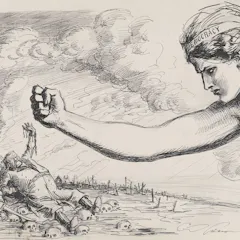
Many citizens are searching for certainty and control in uncertain times. But that means too many are spurning democracy and being seduced by fake news and political strongmen. Democracy needs our help.
Top contributors
-

Principal of South College, Durham University
-
Associate Professor of Instruction in the School of Interdisciplinary Global Studies, University of South Florida
-
Professor of Political Science, Boise State University
-
Professor and Canada Research Chair in Data Mining for Cybersecurity, McGill University
-
Professor and Senior Scholar, Philip Merrill College of Journalism, University of Maryland
-
Associate Professor and Edward and Emily McWhinney Professor in International Relations, Simon Fraser University
-
Associate Professor of Journalism, Mount Royal University
-
Associate Professor of Strategic Communication and Faculty Affiliate at the Sié Chéou-Kang Center for International Security & Diplomacy, University of Denver
-
Associate Professor of History, Indiana University
-
Visiting professor, Harvard University
-
Ph.D. Candidate in Communication, University of South Florida
-
Senior Lecturer, Modern European History and Sports History, Macquarie University
-
Research Assistant, Department of Information Studies, McGill University
-
Associate Professor of Visual Communication & Digital Media, RMIT University
-
Professor of Critical Cultural & International Studies, Colorado State University