
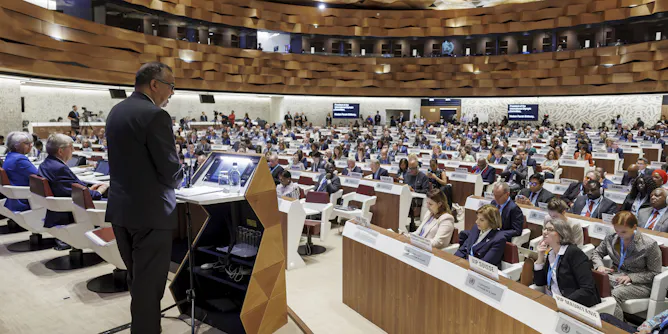
The WHO’s International Health Regulations are the world’s only existing international legal agreement focused exclusively on preventing and addressing infectious disease outbreaks across borders.
Articles on Vaccine nationalism
Displaying all articles

A major lesson from the COVID-19 pandemic is the need to decolonize transnational governance so that the world is better able to handle both future and current global crises.

In places with low vaccination rates, COVID-19 has the chance to linger, and variants develop and travel. Without global vaccine equity, this entirely predictable pattern will repeat itself.
The fight for vaccine equity needs to stop looking to multilateral institutions for permission and instead focus on the policy tools that are already available to states.

African governments, firms and donor agencies should align their efforts to support the local manufacture of vaccines and other health equipment in African countries.

There are three broad sets of health-related opportunities and benefits that may shape the future of India-Africa relations.
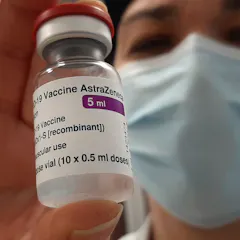
Italy’s decision to block export of AstraZeneca vaccines to Australia will likely not impact our vaccine roll-out. But vaccine scarcity is a looming problem in other parts of the world.

Governments are naturally under pressure to focus on national rollouts. But the truth is none of us is safe until we’re all safe.

Vaccines should be seen as a kind of foreign aid.

With $1 billion in advance purchase agreements for COVID-19 vaccines, Canada has joined the vaccine nationalists: rich countries buying up more than half the global short-term supply of vaccine.

More than 170 countries have signed up to the Global Access (COVAX) initiative, but vaccine hoarding has already begun by many wealthy countries — leaving poorer nations potentially in the lurch.

A two-dose coronavirus vaccine would mean we need to produce 12-15 billion doses. This is roughly twice the world’s current total vaccine manufacturing capacity.

Instead of a global response to the pandemic, we’re seeing an outbreak of vaccine nationalism.

Should the US be able to pre-order vaccines for its citizens when other populations around the globe are at greater risk?
Top contributors
-

Associate professor, University of Sydney
-
Professor of Social Psychology, Royal Holloway, University of London
-
Professor of political science, Director of the Oslo SDG Initiative, Host of "In Pursuit of Development" podcast, University of Oslo
-
Professor of Law, Villanova University
-
Professor of Technology Management, University of Pretoria
-
Canada Research Chair in Aging & Immunity, McMaster University
-
Assistant Professor, School of Nursing, Faculty of Health and Social Development, University of British Columbia
-
Professor of Public Health, La Trobe University
-
Associate Dean of Research and Professor of Politics and International Relations, King's University College, Western University
-
Professor and Distinguished Research Chair, Globalization and Health Equity, L’Université d’Ottawa/University of Ottawa
-
Global Access in Action Program, Berkman Klein Center, Harvard University
-
Associate Professor of Sociology, Thompson Rivers University
-
Professor of Intellectual Property Law, Queen Mary University of London
-
Professor and Director, Centre for African Studies, University of Mumbai, University of Mumbai
-
Senior Research Fellow, Oxford Uehiro Centre for Practical Ethics, University of Oxford