
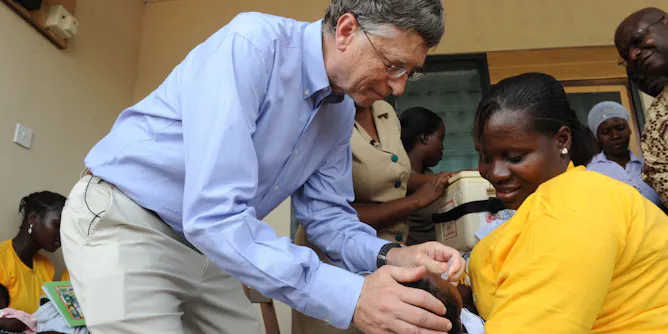
Now that the US has stopped funding Gavi, the vaccine alliance will likely become more dependent on philanthropy than ever before.
Articles on GAVI
Displaying all articles
A major lesson from the COVID-19 pandemic is the need to decolonize transnational governance so that the world is better able to handle both future and current global crises.

The anti-vaccine movement is the product of a structural problem, reflecting a lack of trust in the existing global vaccine governance.

The Trump administration wants to go it alone when it comes to vaccine development and distribution. What does this mean for the U.S. and the world?
The current pneumococcal conjugate vaccine immunisation schedule requires three doses of the vaccine. These are usually the most expensive vaccines in childhood immunisation programmes.
With $1 billion in advance purchase agreements for COVID-19 vaccines, Canada has joined the vaccine nationalists: rich countries buying up more than half the global short-term supply of vaccine.

Should the US be able to pre-order vaccines for its citizens when other populations around the globe are at greater risk?

Rotavirus vaccines are expensive and take time to produce. For developing countries, the fact that the vaccines need cold storage also presents a challenge.

Despite Nigeria’s success in eradicating polio, it is struggling to get a grip on mother and child vaccinations.
Top contributors
-

PhD student at the Australian Institute for Bioengineering and Nanotechnology, Addis Ababa University
-
Board Certified Internal Medicine Physician and Public Health Scientist, MidMichigan Health, University of Michigan
-
Professor and Distinguished Research Chair, Globalization and Health Equity, L’Université d’Ottawa/University of Ottawa
-
Professor of Philosophy, Binghamton University, State University of New York
-
Assistant Professor, School of Nursing, Faculty of Health and Social Development, University of British Columbia
-
Associate Professor of Sociology, Thompson Rivers University
-
Clinical associate professor, Faculty of Medicine, University of British Columbia
-
Professor in Medical Virology, Stellenbosch University
-
Faculty Member at the Department of International Relations, Binus University
-
Professeure titulaire, École de santé publique, Université de Montréal
-
Professor of Law, Villanova University
-
Professor of Cultural Anthropology and International Studies, University of Wisconsin-Madison