
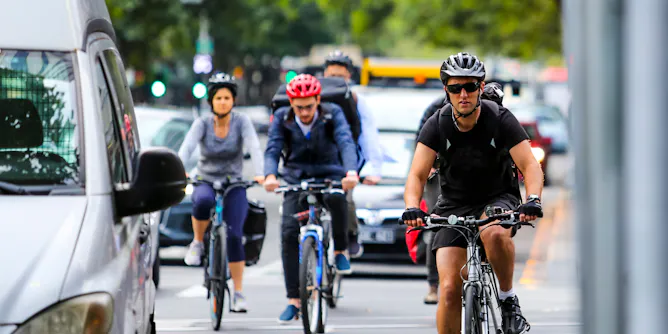
We want healthy, liveable cities and to cut emissions to net zero. Getting more people to use bicycles instead of cars will go a long way towards achieving these goals.
Articles on Transport funding
Displaying all articles

The number of deaths on Australian roads has been increasing steadily year after year. It’s unacceptable not to act on the evidence of what works to boost road safety.

Transport planners estimate money spent on high-quality cycling infrastructure yields benefits between ten and 25 times the costs.
Instead of repeated bailouts, permanent reform of public transport funding is needed.
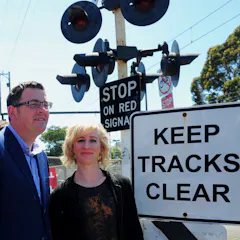
Value capture depends on infrastructure increasing the value of affected areas in the first place. Victoria’s level crossing removal project shows the impact on property values can be significant.
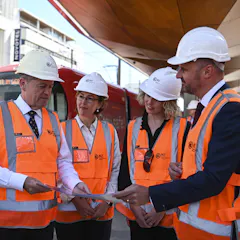
The major parties are promising tens of billions of dollars in transport spending, but only a handful of projects are on Infrastructure Australia’s national priority list with approved business cases.
The Coalition’s infrastructure budgets over this term of government have been around the midpoint of government investment over the past decade. But how projects are chosen leaves a lot to be desired.
In the election bidding wars, parties commit billions to transport projects, often before all the work needed to justify these has been done. More cost-effective alternatives hardly get a look-in.
Billions of taxpayer dollars are committed before all the evidence for, and against, infrastructure projects is in. As well as missing business cases, basic rules of economic modelling are broken.

TfL’s money troubles worsen, as passenger numbers fall for the first time in two decades.

We spend on average about an hour a day travelling. Given this is unlikely to change, how can we make this time more productive and enjoyable?
The real challenge is finding appropriate ways to invest in public transport that will not only take pressure off the system but also support improved travel on all modes, including cars.
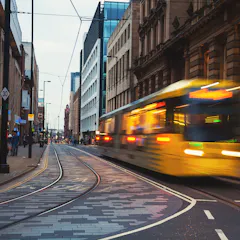
The government claims figures showing the south gets more than the north are misleading.

Reckless government investment decisions are sadly the norm when it comes to transport infrastructure. Three key checks on the decision-making process can help ensure taxpayers get value for money.
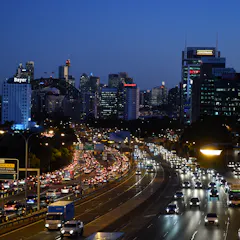
The Australian Automobile Association said that a new report showed that “the average Australian family is spending up to $22,000 every year to get around.” Is that accurate?
The budget paints a picture of higher debt, little relief for growing cities crying out for infrastructure investment, and no detail of how City Deals might work to fix this.
Top contributors
-

Transport and Cities Program Director, Grattan Institute
-
Director, Centre for Western Sydney, Western Sydney University
-
Associate Professor of Property, UNSW
-
Senior Lecturer in Property Economics, Queensland University of Technology
-
Transport Fellow, Grattan Institute
-
Associate Professor in Infrastructure Management, University of Sydney
-
Associate, Grattan Institute
-
Professor and Director, Institute of Transport and Logistics Studies, University of Sydney
-
Professor of Sustainability, Curtin University
-
Researcher in Transport Policy and Governance, UCL
-
Senior Lecturer in Transport and Tourism, Bournemouth University
-
Emeritus professor in transport and logistics, University of Huddersfield
-
Lecturer in Property and Real Estate, Deakin University
-
Senior Lecturer, School of Global, Urban and Social Studies, RMIT University
-
Associate Professor in Urban Infrastructure and Policy, UCL