

Our skin alone can’t actually tell if something is wet.
Articles on Touch
Displaying 1 - 20 of 44 articles
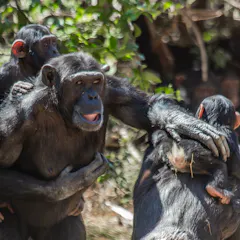
Friendly touching to prevent a fight may be one of our most ancient social tools.

NeeDoh is the latest squishable toy to go viral. But not all sensory objects are toys. Here’s the difference and why it matters.

Sure, a cuddle can feel great. But that doesn’t mean ‘cuddle therapy’ is for you.

Even the traditional five senses don’t operate in silo.
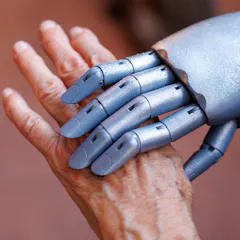
To learn in the way humans do, robots need bodies that feel.

Within a fraction of a second of seeing another person being touched, our brains figure out who is involved and how it might feel.

The most comforting touch communicates care for the person receiving it – not just the intentions of the person offering it.

Daily skin-to-skin contact is important for newborn babies but can also improve parents’ mental health – and children and adolescents.

When asked, students say that touch is important in developing reading and writing skills. Research backs them up.

Our bodies have a dedicated channel for sensing only the very lightest of touches.

A cultural collaboration with deafblind people led to the development of a high-tech device to help navigate their world post-lockdown

A device could be use to transmit a camera’s video feed into moving patterns of electrical stimulation on the surface of the tongue.
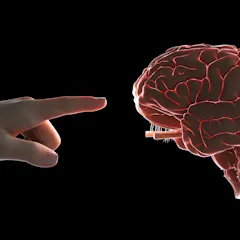
When designing neuroprosthetic devices for users to control with their thoughts, engineers must take into account the sensory information brains collect from the environment and how it gets processed.

It’s intriguing how some people experience ASMR while others don’t - our latest research suggests that many ASMR responders are highly sensitive “orchids”.
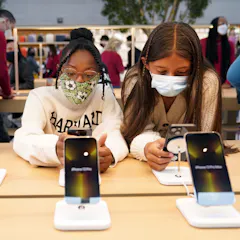
New research shows people experience the ‘endowment effect’ of valuing an object more when they can touch it, even in virtual settings.

When death is looming, the warmth of a held hand can communicate deeply where words fail.

Nobel prizewinning research has revealed the various molecules that help us sense temperature, touch, pain, and even the positioning of our body parts.

These discoveries could help us treat a variety of conditions in the future – including chronic pain.

Lack of human touch can lead to greater stress, anxiety and loneliness – and that is what made the social distancing during the pandemic so hard for many.
Top contributors
-

Associate Professor in Physiology, UNSW
-
Postdoctoral Researcher in Cognitive Neurosciences, The University of Queensland
-
Professor in Neuroscience, Liverpool John Moores University
-
Clinical Psychologist and Associate Professor of Psychology, La Trobe University
-
Carolina Distinguished Professor of History, University of South Carolina
-
Visitor in the School of Biological and Biomedical Sciences, Durham University
-
Professor of Sociology and Gender and Sexuality Studies, Fort Lewis College
-
Associate Research Fellow, Institute of Biomedical Sciences, Academia Sinica
-
Senior Lecturer (Intelligent Bionics and Soft Robotics), Queensland University of Technology
-
Associate Professor of Engineering Science, member of the Oxford Robotics Institute, University of Oxford
-
Associate Professor and Research Leader in Virology and Infectious Disease, Griffith University
-
Hwang Endowed Professor of Computer Science and Engineering and Director of the Center for Neurotechnology, University of Washington
-
Neurological Surgery Resident, University of California, San Francisco
-
Senior Lecturer in Screen Production, School of Culture & Creative Arts, University of Glasgow
-
Reader in Cognitive Science, Cardiff University