
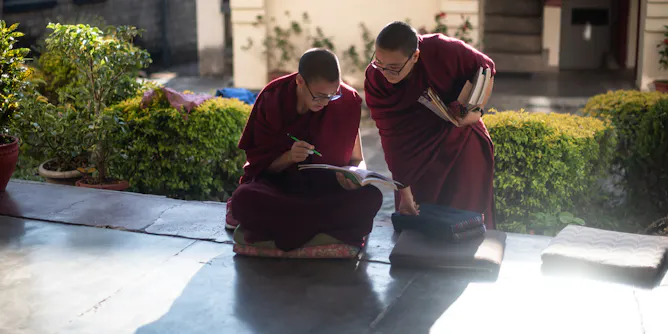
A 2012 change has seen scores of Tibetan Buddhist nuns achieve the highest degree in Tibetan Buddhist philosophy. The implications go beyond just higher learning.
Articles on Tibetan Buddhism
Displaying all articles
Research shows how the Dalai Lama is emerging an an unlikely inspiration for individuals who share trans and Buddhist identities.
Being minimally Buddhist requires a practitioner to abstain from destroying any breathing beings. So how is it ok for some Buddhists to eat meat? Two philosophers explain.

Tibetan Buddhists may face a future of duelling Dalai Lamas: one born in exile who will receive traditional religious training, the other a mouthpiece of the Communist Party.
Beijing is eager for more control over the selection of Tibetan Buddhist leaders like the Dalai Lama.
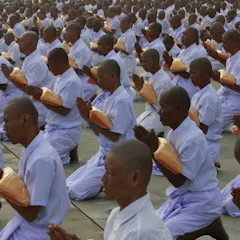
Traditional ordination into a Buddhist monastic life requires meeting guidelines based on male and female genders.
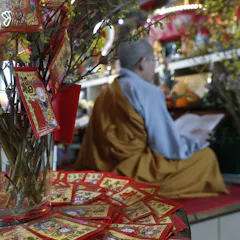
The Mahāyāna branch of Buddhism likely emerged around the first centuries A.D. and was most readily carried through the Silk Road and maritime trade routes.
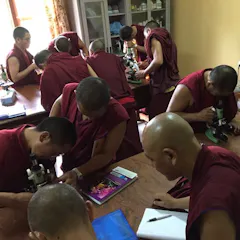
Religious beliefs and modern biology sometimes seem to collide. But exploring those ideas with compassion and an open mind can lead to deeper learning across cultures.
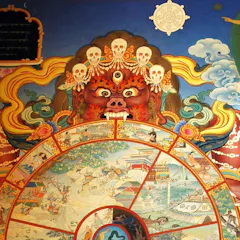
Why is a medieval Tibetan text about death so enduringly popular?
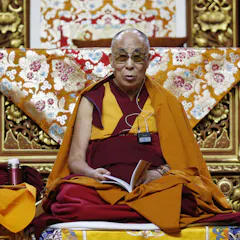
For Tibetan Buddhists it is important that they are in charge of the selection process for the next dalai lama, but China wants to appoint its own.

Winner of the 1992 Nobel Peace Prize and one of the most recognizable faces of Buddhism, the Dalai Lama has turned 84 and the question of a successor is pressing – and controversial.
Top contributors
-

Associate Professor of Religious Studies, Rhodes College
-
Senior Lecturer in Philosophy and Ethics, University of Tasmania
-
Lecturer In Buddhism Studies, The University of Melbourne
-
Adjunct Associate Professor, University of New England
-
Senior Philosophy Lecturer, University of Tasmania
-
Professor of Asian History & Health Humanities, Penn State
-
Assistant Professor of Religious Studies, Case Western Reserve University
-
Lecturer in Sociology, Charles Darwin University
-
Assistant Professor of Biology, University of Richmond
-
Visiting Scholar in Religious Studies, Northwestern University