
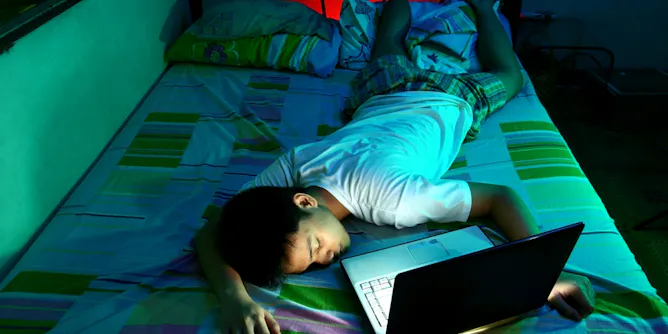
Make sure your teenager doesn’t stay up all night.
Articles on Teenagers
Displaying 321 - 340 of 376 articles

Teenagers spend more time consuming media than they do sleeping. Most of this consumption is passive - a habit that’s creeping into classrooms, too.

Many adolescent pressures are age old, others newer, such as having followers on social media.

Kids today face a variety of digital stressors –from negotiating how much communication to have with close friends to digital abuse.

Sex is part of young people’s lives. So how do we teach young authors to navigate tricky narrative waters when they write about it?
You often hear it said that ‘privacy is dead’. Our cybersecurity expert explains why that’s not true, yet.

Teenagers are more interested in gadgets and flashy desig in their first car than they are about safety features. So how do we make them think safety is important?

Teenagers spend one-third of their lives sitting down and three hours a day watching TV. New findings confirm that it’s not just their health that is at risk.

Teenagers need to make friends outside their own cliques – and schools should help them.

New research shows that depression doesn’t spread between teenagers but having mentally healthy friends can protect you.

Fewer teenagers are taking up smoking, but one study has found a link between e-cigarettes and a potentially more dangerous addiction.

Growing up is never easy – especially when your childish status updates are still online.

Only 1% of adolescent friendships last the distance - but could our schools be the real root of the problem?

Parents tend to have greater expectations of their firstborns. But, it’s different when the younger sibling is a girl. What impact does it have on their grades?

Young men are being forgotten when it comes to teenage pregnancy but helping them share responsibility could have a big impact.

Death rates for young men with type 1 diabetes in the UK have shot past similar figures for Western Europe. Greater focus on adolescents could save lives.

Teenagers need to trust their parents and learn about trusting others. Apps like Teensafe might undermine both.

The instinctive response to Islamic State propaganda is to counter it with more propaganda. But my analysis shows that’s not working. We should not play their game on their field with their ball.

A new study has suggested the answer is one hour a day. But that might not be right for everyone.

Should cyberbullies be isolated and shamed? Or should they be helped ? Victims of cyberbullying could take to being cyberbullies themselves.
Top contributors
-

Research Officer at Medical School, Swansea University
-
Professor of Psychology, San Diego State University
-
Professor in Public Health Data Science, Swansea University
-
Director of the International Gaming Research Unit and Professor of Behavioural Addiction, Nottingham Trent University
-
Emeritus reader in science education and communication, University of Sussex
-
Assistant Professor of Social Work, University of Michigan
-
Associate Professor at the Health Services Management Centre, University of Birmingham
-
Professor of Psychiatry and Neuroscience, Wayne State University
-
Assistant Professor of Psychology, Wayne State University
-
Lecturer, School of Nursing and Midwifery, Queen's University Belfast
-
Researcher, Digital Wellbeing, Western Sydney University
-
Professor, University of Sydney; RMIT University
-
Professor of Psychology, Bridgewater State University
-
Senior Research Fellow in Organizational Leadership, Policy and Development, University of Minnesota
-
Professor of Adolescent Health, Co-Head of the General Practice Clinical School, University of Sydney