
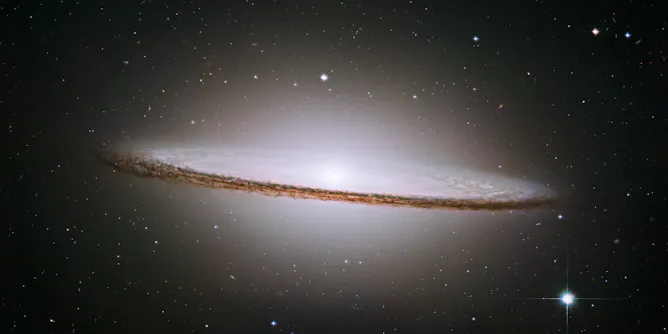
As galaxies get older they get rounder, and fall victim to the middle-aged spread that catches many of us humans here on Earth.
Articles on Star formation
Displaying 21 - 39 of 39 articles
Massive, far distant galaxies contain 100 times more gas than we thought possible.
The science of red skies can also help us understand how stars form.

It’s like one great big distillery up there.
Astronomers are surprised by what they’re finding out about galaxies that formed in the early days of our universe, now that sensitive telescopes allow direct observation, not the inference of old.
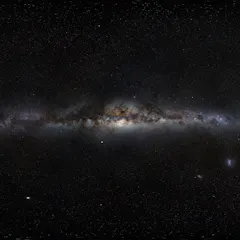
Understanding how the billions of stars in our galaxy formed and evolved is the subject of a huge galactic archaeology project.
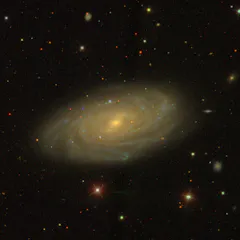
Galaxies are supposed to be the place where new stars are formed. So what causes some to stop this stellar production line?
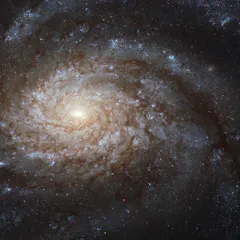
Extragalactic astrophysicists want to know how and why galaxies stop forming stars, change their shape and fade away. With help from citizen scientists, they’re figuring it out.
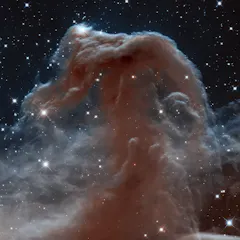
Astronomers have built a new observatory in the cold dry air of a high plateau in Antarctica to peer through our atmosphere and observe carbon in our galaxy.
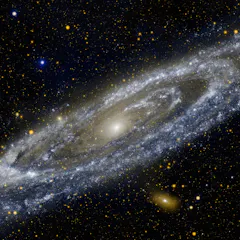
If some of the laws of physics were only infinitesimally different, we would simply not exist. It almost looks like the universe itself was built for life. But how can that be?
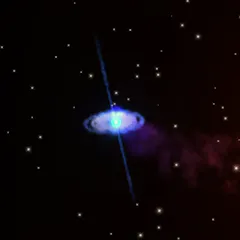
They’re are the overachievers of the universe: incredibly dense but very small when compared to others stars. So how much do we know about the extreme behaviour of neutron stars?
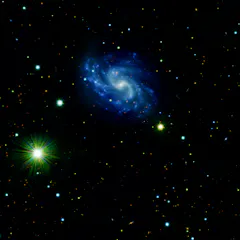
Our universe’s most exciting days are well behind us, with new research showing the universe is now slowly but surely dying.
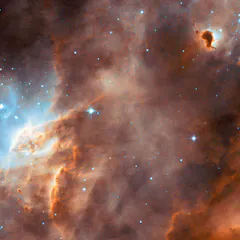
Researchers have created a star-forming cloud in the laboratory to try to recreate the first-ever biological molecule. The study could explain why such molecules are left-handed.
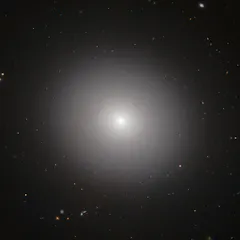
What happens to a galaxy when it runs out of the stuff needed to forge new stars?
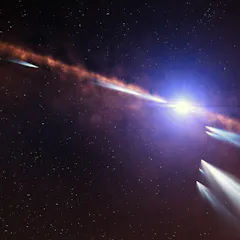
A detailed study of comets orbiting the young nearby star Beta Pictoris is published today in the journal Nature, and it reveals striking similarities to the comets found in our solar system. Over the…
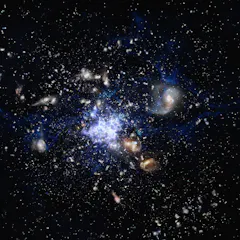
Clusters of galaxies have back-stories worthy of a Hollywood blockbuster: their existences are marked by violence, death and birth, arising after extragalactic pile-ups where groups of galaxies crashed…
What makes our sun shine has been a mystery for most of human history. Given our sun is a star and stars are suns, explaining the source of the sun’s energy would help us understand why stars shine. An…
A piece of the galaxy formation puzzle may have fallen into place, thanks to a team of European and American astronomers peering into the depths of our early universe. According to new research published…
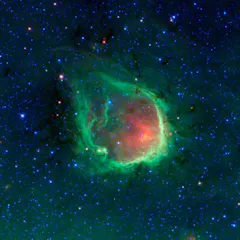
The current theory of star formation has a problem: it cannot make big stars. In the standard star-making recipe, stars are formed in the depths of gas clouds made from molecular hydrogen. These clouds…
Top contributors
-

Professor (Astrophysics), University of Southern Queensland
-
Associate Professor, Japan Aerospace Exploration Agency (JAXA)
-
Research Associate, Curtin University
-
Senior Curator (Astronomy), Museums Victoria Research Institute; The University of Melbourne
-
Senior Lecturer in Radio Astronomy, Curtin University
-
Professor in Physics and Astronomy, UNSW
-
Research Associate Professor & UWA Research Fellow, The University of Western Australia
-
Associate Professor in Astronomy, Monash University
-
Professor of Astrophysics, University of Sydney
-
Professor and Director of the Centre of Excellence for Data Science, AI and Modelling, University of Hull
-
Professor (Physics), University of Southern Queensland
-
PhD student in observational astronomy, Monash University
-
Honorary Research Fellow, Physics and Astronomy, University of Glasgow
-
Professor of Astronomy & Astrophysics, University of California, Santa Cruz
-
Research Scholar, Academia Sinica