
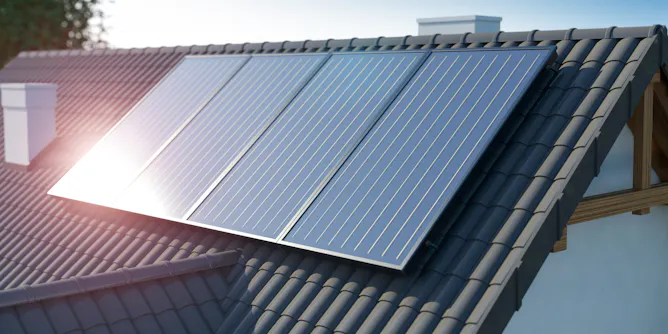
New social housing can provide a safe, secure and climate resilient home for tenants.
Articles on Solar power
Displaying 161 - 180 of 385 articles
In a bid to ditch fossil fuels, some countries are considering carpeting deserts with solar panels.

Solar power doesn’t have to be just for the wealthy anymore. With the right kind of financial incentives, households at all income levels can benefit from affordable clean energy.

Chemicals found in food and solar cell technology have an interesting history – as my own research shows.

Weak regulation and a lack of mandatory inspections have increased fire risks for the one in four homes with rooftop PV panels. Here’s what we need to do to be safer.

Changes to the way houses and other buildings are constructed could lower energy use and greenhouse gas emissions.
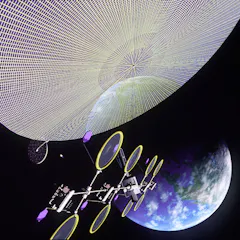
How solar power stations in orbit could become a reality in the coming decades.

Many Asian nations are shunning fossil fuels, presenting a huge opportunity for Australia’s renewables sector. And one massive project has stepped up to the plate.
Our research identified three key lessons.
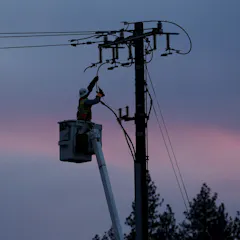
In an era of climate change and extreme weather, a microgrid — a self-sufficient, energy-generating distribution and control system — puts communities on the path to self-reliance.

Building renewable energy infrastructure involves mining for materials such as lithium, graphite and cobalt. If not done responsibly, that could cause huge environmental damage.
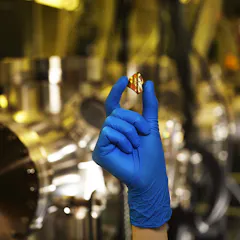
Halide perovskites are cheap, versatile and remarkably efficient as both solar cells and light emitters.

Energy companies are marketing a new fuel: ‘renewable’ natural gas. But it’s not the same from a climate change perspective as wind or solar energy.
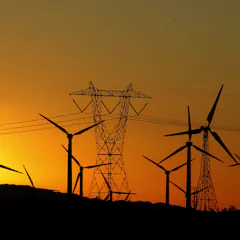
Renewables technology already exists, it’s getting cheaper and we will never go to war over sunshine. If you need to be convinced of the potential of wind and solar, read this.

Are facilities that produce necessities like energy and clean water doomed to be ugly? Not when artists and landscape architects help design them.
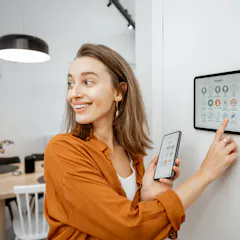
How indoor solar cells could help power the Internet of Things.
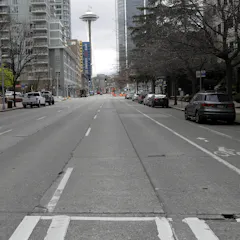
The US is gradually shifting to lower-carbon energy sources, but the COVID-19 pandemic, an oil price crash and a likely recession are big speed bumps.
New lightweight, efficient and ultra-thin solar technologies show promise, but it may be too soon to abandon conventional solar photovoltaics.
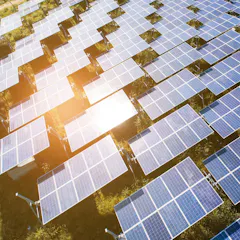
Sun Cable could provide Australia an alternative to the export business of coal and gas, and even reduce our export dependence on China.
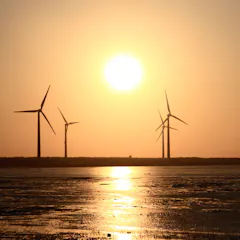
Pumped thermal electricity storage turns electricity into heat and back again – which can compensate for the intermittent supply of renewables.
Top contributors
-

Professor of Engineering, Australian National University
-
Professor Emeritus, Macquarie Business School, Macquarie University
-
Senior Research Associate, Renewable Energy & Energy Systems Analyst, UNSW
-
Honorary Associate Professor, UNSW
-
Professor of Physics, University of Johannesburg
-
University of Southern Queensland
-
John M. Thompson Chair in Information Technology and Innovation and Professor, Western University
-
Senior Industry Fellow, Environment and Planning, RMIT University
-
Professor of Sustainability, Curtin University
-
Emeritus professor, Australian National University
-
Lecturer in Energy Storage Systems Dynamics, Lancaster University
-
Research Fellow, Stephenson Institute for Renewable Energy, University of Liverpool
-
Professor in International Relations / International Political Economy, UNSW
-
Research Scientist, The University of Texas at Austin
-
Assoc Prof. Renewable Energy, Monash University