

Research on perceived similarities between people and their dogs aims to understand whether such perceptions are accurate and how they affect the relationship between people and their dogs.
Articles on Psychology
Displaying 321 - 340 of 2365 articles

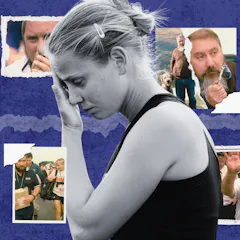
The cult of Michaela Kell might seem funny but it involves dark psychological manipulation, like any other.
Not all of us get to grieve a stable and warm relationship. We may feel complicated emotions beyond sadness.

A social psychologist recommends ways to connect with others as you move through public spaces – with benefits for your own well-being as well as for the social fabric of your community.

Procrastinating can be a coping mechanism for anxiety, but usually only works in the short term.

Boosted by algorithms, many influencers are framing suffering as fitness, and failing young men in the process.

Disgust is a primal emotion – and it could be the key to eating less meat.

A global study seeks insights into what helps people feel happy, healthy and satisfied – and what holds them back.
When it comes to consciousness, theories are like toothbrushes. Everybody has their own and nobody wants to use anybody else’s.

We love to believe we’re rational thinkers, but we’re often guided by invisible hands.

Habits are more like planting seeds than flipping switches. They take time, care and patience to grow.

An object’s color appears differently under different lighting and against different backgrounds − for different viewers. But that doesn’t mean colors are subjective.

The Let Them world is far removed from the interconnected reality of social life, writes Nick Haslam. But books such as this may be useful.

And why people form alliances even with people they know are untrustworthy.
Most of us are not consciously aware of the mental blueprints that can affect our mental health and perceptions of ourselves.

Use stories, rhymes and acronyms that catch your imagination.

Not too long ago, therapists created a wall between themselves and their patients. Have we gone too far in the other direction?
A psychologist explains how group identity, polarizing issues and social media are driving people apart – and suggests some remedies.

Ten comedians, one room, last comic to laugh wins. But what makes comedy – and not laughing – so funny?

Researchers probed what psychologists call the ‘paradox of effort’ to learn how different people value work they could do in the future or that they’ve already accomplished in the past.
Top contributors
-

Professor of Psychology, The University of Melbourne
-
Senior Lecturer in Psychology, Leeds Beckett University
-
Professor of Psychology, Edge Hill University
-
Cornelia H. Dudley Professor of Psychology, Knox College
-
Professor of Psychology, Monmouth University
-
Associate Professor in Clinical Psychology and Neuropsychology, Trinity College Dublin
-
Professor of Cognitive Psychology and Director of the Institute for Climate Risk and Response, UNSW
-
Associate Professor, School of Psychology, UNSW
-
Professor of the Psychology of Time, Liverpool John Moores University
-
Associate Professor, Centre for Positive Health Sciences, RCSI University of Medicine and Health Sciences
-
Chair of Cognitive Psychology, University of Bristol
-
Professor of Consumer Psychology, Anglia Ruskin University
-
Professor of Social Psychology, Anglia Ruskin University
-
Senior Lecturer in the School of Psychology, University of Lincoln
-
Professor, Melbourne School of Psychological Sciences, The University of Melbourne