
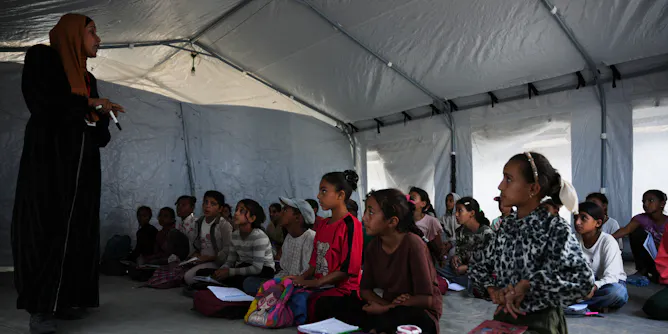
Understanding emotional concepts like qahr is essential to supporting educators and students living under occupation, war and violence.
Articles on Pedagogy
Displaying 1 - 20 of 46 articles

Teaching should encourage discovery, curiosity and problem solving. Why are teachers holding back?

The second world war marked a turning point in the history of childhood. To train young people to build peace, authorities reinvested in schools and introduced new pedagogies.

Conditional cash transfers can increase access to education – but they need to be accompanied by other measures to boost literacy.
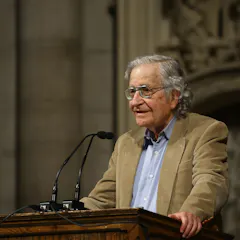
Noam Chomsky’s notion of the human instinct for freedom ties together his many intellectual pursuits, from educating creative, independent citizens to rejecting social and economic hierarchies.
It’s important to position students as collaborators and co-creators of knowledge.

The late Justice Sandra Day O'Connor’s iCivics curriculum has been shown to boost knowledge of the political process.
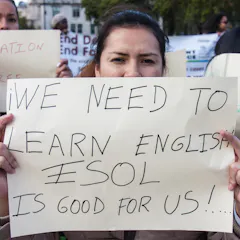
Although English to speakers of other languages (Esol) is treated like any other subject, it can offer far more to those learners.

Simply setting aside time for collaboration doesn’t always lead to better outcomes for teachers or students. Effective collaboration requires skilful leadership and a common language.
In 2008 the groundbreaking education book ‘Visible Learning’ was released. A sequel published this month finds teaching is still the most important factor when it comes to student learning

Exceptional teachers can leave a lasting impression on more than just their learners.
Early childhood education isn’t about warehousing children so adults can go to work. There is an ethical imperative to support a paradigm shift in how our society values educating young children.

Smart, capable students struggled to navigate cultural and language norms in university accounting classrooms.

The devastation of the second world war allowed progressive planners to reimagine the city and make spaces for children and young people to play in.

Africans are adopting podcasting as a way of telling their own stories. In one class in Egypt, this took a feminist turn.

Multilingual teaching was a challenge under emergency remote learning conditions: computer systems weren’t adapted to indigenous languages.

The question for all educators should be: How do we capitalize on COVID-19 initiated change to build better education systems for the future?
What Kenya should focus on is providing in-service professional development to improve student learning outcomes.

A recently released schools policy guide has been receiving some criticism. Reports suggest it instructs teachers to not use terms like “boys and girls”, for instance. This is not entirely correct.

Some students may wonder why they bothered returning to campus. Others are struggling online. But lecturers who do engage students think deeply about how they do it, using all available tools.
Top contributors
-

Associate Professor, University of the Witwatersrand
-
The University of Western Australia
-
Reader, Department for Health, University of Bath
-
Emeritus Professor of Education, University of Derby
-
Assistant Professor of Mathematics Education, University of Maryland, Baltimore County
-
PhD Researcher in the Department for Health, University of Bath
-
Assistant Professor of Journalism, University of Oregon
-
Professor & Head, School of Science & Mathematics, Mauritius Institute of Education
-
Emeritus Professor Miraca Gross, UNSW
-
Research Associate, Faculty of Education, University of Cambridge
-
Educator and Researcher, The Partnership for African Social and Governance Research (PASGR)
-
Emeritus Professor of Education and Director of Oracy Cambridge, University of Cambridge
-
Associate Professor of Practice, Center for Learning and Teaching, American University in Cairo
-
Chercheure Associée au laboratoire ACTé, Cheffe de projet Learn'in Auvergne pour l'innovation pédagogique, Université Clermont Auvergne (UCA)
-
Professor of Language, Literacy and Culture and Director of the Center for Social Science Scholarship, University of Maryland, Baltimore County