
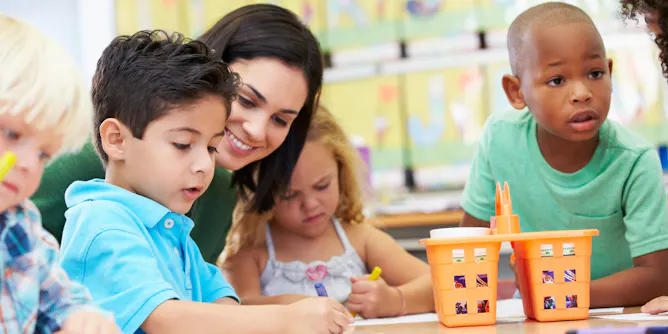
There are lots of ways teachers greatly influence children’s outcomes, including improving motivation and resilience.
Articles on Parents
Displaying 241 - 260 of 339 articles

The education minister says that under Labor there were child care price spikes of up to 14% over a 12 month period, but under the Coalition those have fallen to “around 6% on average”. Is that right?

Exposure to nature plays a positive role in brain development by providing children with opportunities to take risks, discover new things, and be creative.

Welcome to the controversial world of sleep consultancy, where coaches and counsellors train new born babies to ‘sleep through the night’.

From the informative to the whimsical to the flat out hilarious, here are ten Australian books to keep your child’s brain active through the holidays.

Telling parents how to love their child undermines parental confidence.
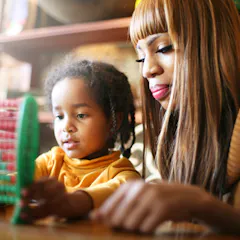
The questions young people tend to ask about maths often relate to their personal experience of how they found maths in school.

White middle-class parents get an easy time of it when it comes to parental involvement.

Understanding where teens learn about sex and how that influences them can help us find ways to encourage healthy sexual behaviors, such as using condoms and birth control.

Parents of children who have complex healthcare needs often find their role as a mother or father is overwhelmed by all the clinical tasks they have to undertake.

Some youths find in gangs the love and social standing that’s missing in their home lives.

The perils of bug parenting.

An increasing number of parents are choosing to toilet train their children from birth, without using nappies. But how effective is this?

The lead author of a new American Academy of Pediatrics statement summarizes important guidelines for children’s use of electronic devices.

Young people actually take responsibility for their own financial decisions but they fail to learn from their parents about how to handle money, new research shows.

Praising kids in a generalised way through phrases like, ‘well done’ or ‘aren’t you clever’ isn’t helpful and can actually damage children.

Any reforms must move beyond a focus on administrative processes to acknowledge the lived experiences of child support which can be disguised by formal policy.

Decreasing levels of empathy in young people are partly due to changes in parenting styles that came about in the 1980s.

Any new approach to linking welfare payments to attendance must address the flaws of previous trials. It will require the cooperation of schools and the availability of accurate, real-time data.

The focus on reducing welfare dependency among young carers, parents and students may deter them from seeking any help.
Top contributors
-

Professor, Canada Research Chair in Determinants of Child Development, Owerko Centre at the Alberta Children’s Hospital Research Institute, University of Calgary
-
Senior Lecturer in Education, Queensland University of Technology
-
Professor of Child Public Health, Swansea University
-
Adjunct Professor, School of Nursing and Midwifery, Western Sydney University
-
Assistant Professor of Sociology, University of South Carolina
-
Associate Professor Leeds University Business School, University of Leeds
-
Lecturer, School of Education, Edith Cowan University
-
Professor of Educational Inclusion, Newcastle University
-
Emeritus professor of children's literature, University of Canberra
-
Lecturer in Educational Leadership and Management, University of Bath
-
School Education Program Director, Grattan Institute
-
Professor in Child Health Literacy, Edge Hill University
-
Senior Lecturer, School of Early Childhood and Inclusive Education, Queensland University of Technology
-
Senior Lecturer in Early Childhood Studies, Charles Sturt University
-
Honorary Senior Fellow, The University of Melbourne