
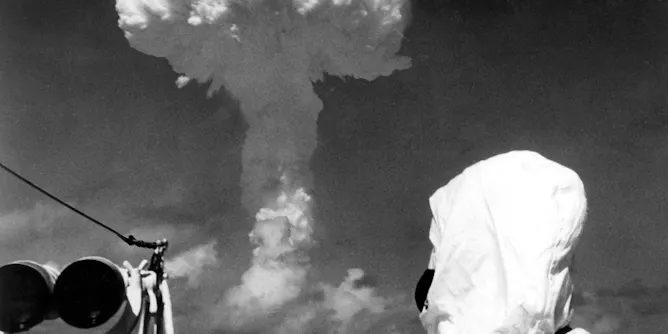
Communities and servicemen have long argued they were harmed by fallout from above-ground nuclear weapons tests – but the UK government has always denied this.
Articles on Nuclear tests
Displaying 1 - 20 of 43 articles

When I talk about my anthropological fieldwork, many Americans are shocked to learn that “living on a nuclear test site” is even a logical statement.
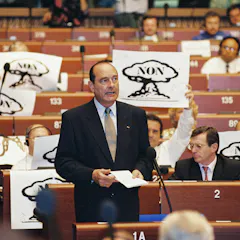
Three decades after France’s last nuclear tests, those living near the test sites still await compensation for the harms caused.

In the 1970s, a huge concrete dome was built on Runit Island to cover some 85,000 cubic metres of radioactive waste dumped by the US. It still leaks radiation today.
Manchester mayor Andy Burnham suggests the treatment of nuclear test veterans will be the next major UK public scandal to emerge. But how do the local people of Kiritimati recall these tests?
Fears are growing that Russia may be trying to put a nuclear weapon into orbit.

The Starfish Prime test in 1962 showed how dangerous it would be to detonate a nuclear weapon in space.
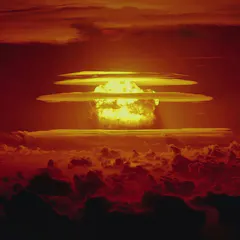
Listening for underground nuclear explosions amid the constant rumble of earthquakes is like looking for a needle that may not exist in a haystack the size of a planet.

The United States and Russia, the two biggest nuclear powers, have no imminent plans for talks on a nuclear deal. That should change, writes a former US diplomat.
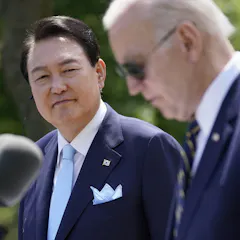
The ‘Washington Declaration’ unveiled during the state visit by South Korean President Yoon Suk Yeol gives Seoul a greater role in coordinating a nuclear response strategy.
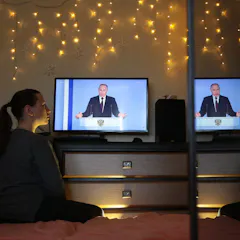
Putin’s announcement to Russia will no longer participate in the New START pauses the last remaining nuclear weapons agreement between the U.S. and Russia.

Should the capsule not be found immediately, we can’t just write it off as lost. A long term system of monitoring is needed to protect humans and the environment.
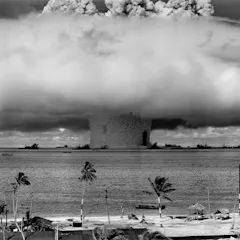
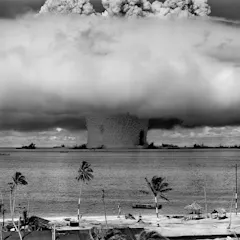
The cinematic legacies of Operation Crossroads, the first peacetime nuclear tests, fundamentally shaped how we view the mushroom cloud.
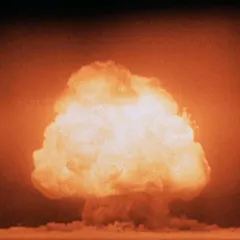
The quasicrystals were ‘accidentally’ synthesised during the first test of a nuclear bomb in July 1945.
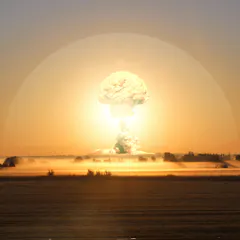
It’s not only nuclear bomb tests that disrupt the atmosphere, there are a number of natural events that can do the same. But how long does any damage last?

Seventy-five years after the first nuclear detonation and nearly 30 years since testing was banned, the US is considering resuming live nuclear testing.
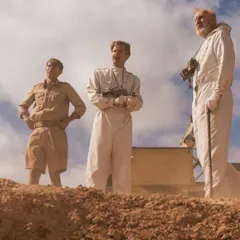
Two ABC television premieres – both about the mid-century British nuclear testing at Maralinga in regional South Australia – approach tricky territory in very different ways.

Finding could be useful for attempts to manipulate the weather using technology.
The findings will help determine the age of whale sharks, protecting the endangered animals into the future.
Russia appears to have developed a revolutionary mini-reactor able to power a missile.
Top contributors
-

Professor of History, Faculty of Business and Creative Industries, University of South Wales
-
Emeritus Professor, School of Environment and Science, Griffith University
-
Online Learning Advisor - Security and International Relations, Swinburne University of Technology
-
Deputy Director, Center for Cyber and Homeland Security, Auburn University
-
Researcher, Social History/Tutor in Medical Education, University of Dundee
-
Professor of International Studies, Dongseo University
-
Professor in International Relations, Head of Inclusion and Development, Aston University
-
Associate Professor of International Relations, The University of Queensland
-
Timothy J. Jorgensen is a Friend of The Conversation.
Director of the Health Physics and Radiation Protection Graduate Program and Professor of Radiation Medicine, Georgetown University
-
DECRA Fellow, Department of Nuclear Physics and Accelerator Applications, Australian National University
-
James Martin Research Fellow, Future of Humanity Institute & Oxford Martin School, University of Oxford
-
Pro Vice-Chancellor of Research, University of Technology Sydney
-
Professor of Political Science, University of Connecticut
-
Professor and head of professional development GRS, James Cook University
-
Senior Lecturer in Asian Politics, School of Social and Political Sciences, The University of Melbourne