
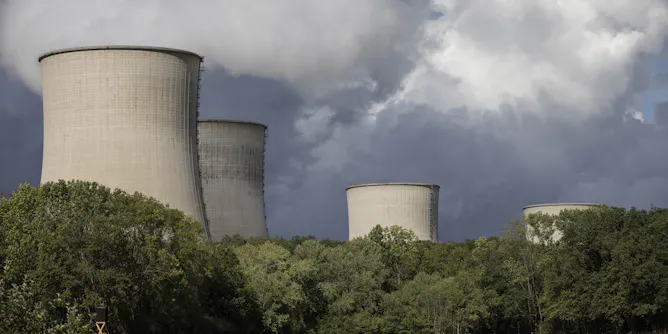
As Canada develops new nuclear projects, some might worry that hotter weather could undermine nuclear reliability. However, France’s experience this summer suggests otherwise.
Articles on Nuclear power plants
Displaying 1 - 20 of 108 articles
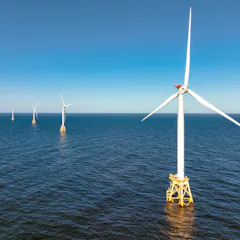
States take the lead on regulation of planning, site selection, leasing and other elements of offshore wind projects in the Great Lakes, though the federal government has a role as well.

The new federal law favors energy technologies that are already profitable and increase global warming over cleaner approaches that could use the investment support.
Some technologies could rapidly cut emissions, while others do little to fight climate change. The House bill favors the latter while nixing support for the former.

The decades-long struggle to find a permanent place to dispose of nuclear waste will continue, probably for many years to come.

Three years ago, Ontario’s Doug Ford won an overwhelming majority government on the basis of the ballots of less than 18 per cent of the province’s eligible voters. Are voters still disengaged?
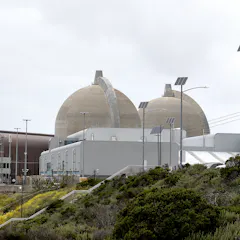
Public sentiment related to nuclear power remains highly contentious. As nuclear energy regains momentum, its path forward will require rebuilding public trust.

A successful transition to clean energy is vital to Australia’s prosperity. But the Coalition’s latest nuclear salvo leaves many unanswered questions.

The only way to make nuclear power work in Australia is to unplug cheap renewables. Stop exporting electricity from rooftop solar system. Forget feed-in tarrifs. Everyone use baseload nuclear first.

Ghana looks in the direction of nuclear power for help in achieving its industrial ambitions while contributing to the fight against climate change.
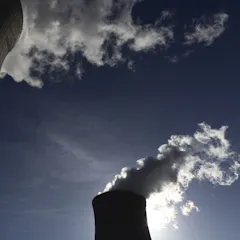
If a future Coalition government were to bring nuclear into the mix, energy costs for residential and especially industrial customers would likely increase.

The Coalition’s nuclear plan is an unwelcome proposal which will slow the energy transition and increase our dependence on gas – a surefire way to drive up energy bills.

Insisting nuclear power is the only way for Australia to achieve net zero by 2050 is a classic move from the playbook of those who oppose urgent action on climate change.
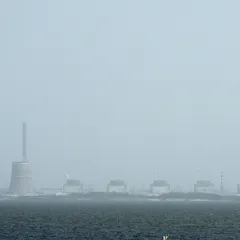
The Russian invasion of Ukraine has placed Ukraine’s nuclear sites under considerable threat with a growing risk that further conflict may lead to radioactive contamination.

Civil nuclear energy maintains the skills and supply chains needed for nuclear subs and weapons.
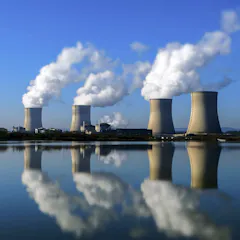
When Australia’s government and opposition argue over how to get to net zero emissions, nuclear power is the flashpoint. The argument against nuclear is stronger, but not for the obvious reason.

The costing, put out by the Climate Change and Energy Minister Chris Bowen, is a pre-emptive strike against the opposition, which is moving to include nuclear power in the energy policy it takes to the next election
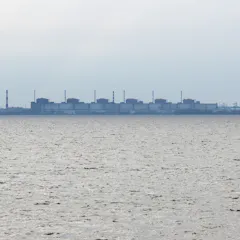
The International Atomic Energy Agency says the plant has enough water to last for several months. What happens afterward or if the remaining water is lost to the war could lead to a disaster.
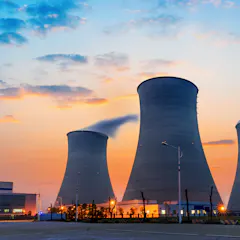
A new process to quickly remove radioactive chemicals from water and other liquids and trap them in a clay-like substance could make nuclear waste management much easier.
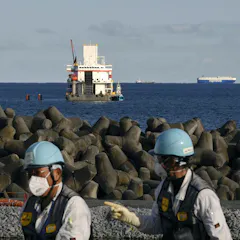
Japan’s Fukushima Daiichi Nuclear Power Plant is set to release radioactive wastewater into the Pacific Ocean – but the cause for concern is minimal.
Top contributors
-

Professor of Physics, University of Johannesburg
-
Professor of Engineering and International Relations, University of Southern California
-
Simons Chair in Disarmament, Global and Human Security at the Liu Institute for Global Issues, University of British Columbia
-
Professor, Environmental and Urban Change, York University, Canada
-
Sociologue, IMT Atlantique – Institut Mines-Télécom
-
Professorial Fellow, University of Canberra
-
Timothy J. Jorgensen is a Friend of The Conversation.
Director of the Health Physics and Radiation Protection Graduate Program and Professor of Radiation Medicine, Georgetown University
-
Lecturer in International Studies, University of Washington
-
Professor, Mathematical Sciences Institute and School of Computing, Australian National University
-
Honorary Senior Research Associate, UCL Energy Institute, University College London, UCL
-
Professor, School of Economics, The University of Queensland
-
Reader in Energy Policy, University of Aberdeen
-
Director of Energy Studies, University of Florida
-
Directeur du Centre de recherche sur les risques et les crises et chercheur au sein du Collège des Sciences Navales, Mines Paris - PSL
-
Professor of Civil and Environmental Engineering, Rice University