
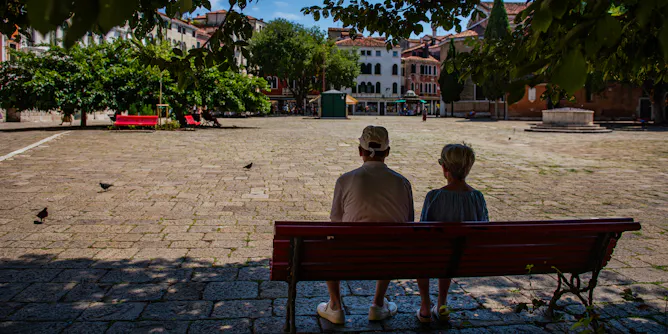
From floodlit beaches to late-night libraries, city life has to change to beat the heat.
Articles on Nightlife
Displaying 1 - 20 of 37 articles

Night running is seen as a form of spiritual possession in the communities where it’s common.

As cities debate how to sustain the nighttime economy while keeping residents safe, Montréal’s past reminds us that the way we govern the night determines who gets to belong in it.

Those on the gay scene can feel forced into changing how they present themselves to gain access to LGBTQ+ pubs and clubs

Summer is here, together with its host of sun-drenched paraphernalia. One marketing scholar takes a look at our relationship to the emblematic cocktail, Aperol spritz.
Nighttime is much more than a source of danger or an occasion to party – it’s a portal into a different world, with rhythms, challenges and lifestyles of its own.
Recent research shows how the relationship between alcohol consumption, queuing and crowds can lead to violent behaviour in city centres at night.
The restrictions that have hurt the live scene will remain for a little while longer, following Boris Johnson’s announcement

The fast-paced move to digital spaces after the pandemic has expanded possibilities for finding community and support in adverse circumstances.

Amid the controversy over Sydney’s lockout laws, a program that looked out for people at risk of harm in the city’s nightlife precincts more than proved its worth.

DJs had to adopt live streaming during the pandemic. This new way of reaching audiences has created a whole new djing experience that is more accessible to a wider range of people.

If bars are forced to restrict people’s movement in our post-coronavirus pandemic world, they will lose some of their most important social functions.

Their loss affects those in the LGBT community who have the least to lose.

The nightlife sector was operating in crisis mode since before the current pandemic, and global strategizing for the future of after-dark industries is already well underway.
The collection and analysis of data used for making policy should be independent and open to ensure public trust in decision-making. The debate over alcohol licensing shows why this matters.
The good news is that the growth of live music continued under Queensland’s liquor licensing reforms. The bad news is that venues rely on late-night alcohol sales to cover costs.

Rates of unwelcome advances haven’t changed under Queensland’s ‘Tackling Alcohol-Fuelled Violence’ policies. In one entertainment district, it happened to 26% of women the night they were interviewed.

Even after ‘Tackling Alcohol-Fuelled Violence’ policies took effect in 2016, Queenslanders still drink more heavily on nights out. Reported levels of aggression are higher than in other states too.

A comprehensive two-year evaluation of statewide measures introduced in 2016 has shown it’s possible to reduce alcohol-related violence while also producing economic benefits.

Something needed to be done to mask the taste of bootleg alcohol that could include ingredients ranging from dead rats to wood tar.
Top contributors
-

Professor, Director of Research and Statistical Support Service and Program Leader for Substance Use and Mental Health, Centre for Health Services Research, The University of Queensland
-
Professor of Violence Prevention and Addiction Studies, Deakin University
-
Senior Lecturer in Criminology, UNSW
-
UQ Amplify Senior Research Fellow, School of Public Health, The University of Queensland
-
Lecturer in Geography, Newcastle University
-
Emeritus Professor of Urban Design, University of Westminster
-
Research Fellow, Deakin University
-
Professor of Urban Media Studies, Department of Art History and Communications Studies, McGill University
-
Professor in Human Geography, Royal Holloway, University of London
-
Senior Lecturer in Design History, Kingston University
-
Director, UWA Public Policy Institute, The University of Western Australia
-
Senior Lecturer in Music, The Open University
-
Lecturer in Writing for Screen and Stage, University of York
-
Senior Lecturer in American Literature and Film, Loughborough University
-
Post-doctoral Fellow NRF Chair: Local Histories, Present Realities, University of the Witwatersrand