

SMEs could help the UK maintain its position as a climate change champion and ensure a long-term future for all businesses, large or small
Articles on Net zero emissions
Displaying 141 - 160 of 288 articles
With its IPPO partners, The Conversation is addressing some of the biggest policy challenges.

The transition to net zero emissions is under grave threat if governments do not do more to address the potential unfairness of some climate policies.

Australia’s move towards net zero emissoions by 2020 is in danger of stalling. If it is not to fail, the nation urgently needs a government plan, aligned with industry and with public support.
Big name food brands are pursuing decarbonisation – but they are squeezing farmers in the process.
The Biden Administration’s signature climate legislation is unleashing a wave of clean energy investment, along with some opportunities and risks for countries like Australia.
The forum is also critical of Australia on several other fronts, including income support for the unemployed, job market flexibility and the recognition of trade qualifications.
Getting to Zero, a new series in The Conversation starting today, examines how – and whether – Australia can meet its net zero emissions target by 2050.

People who switch from gas to reverse-cycle air conditioning to heat their homes still want to feel comfortable. Some don’t. Home electrification programs must tackle the causes of the problem.

The government wants offshore wind to form the backbone of the UK’s future electricity system – but a key auction has delivered no new projects.

We’ve wasted a lot of time delaying climate action. As the damage becomes ever clearer, it’s time to accelerate the transition.
Rishi Sunak has delayed some of the UK’s key net zero targets – a look back at history may explain why.

A new report explores options for managing the period after global warming exceeds 1.5°C. This is called ‘climate overshoot’, because we’re pushing past the safe zone into dangerous climate change.

Lithium-ion batteries are holding back the full-scale decarbonization of Canada’s energy grid. Zinc-ion batteries may be the solution.
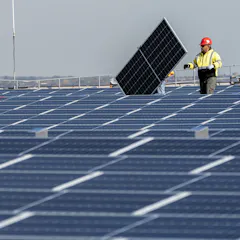
The demand for the minerals needed to build clean energy technology currently exceeds the available supply. If this issue continues, governments may find it hard to reach their clean energy targets.

The annual prizes for Australian science recognised efforts to confront the key challenges facing our world.

Heat pumps are relatively scarce in the UK – but that could be about to change.

The power of storytelling to help inform our decisions is underappreciated and of vital importance in envisioning a better future, and the steps to take to get us there.

Figuring out who is responsible for cutting a city’s emissions and how their efforts will be coordinated is complicated.

Reneging on climate commitments indicates the UK government’s misreading of public attitudes.
Top contributors
-

Professorial Fellow, University of Canberra
-
Program Director, Energy and Climate Change, Grattan Institute
-
Assistant Director of the Global Systems Institute, University of Exeter
-
Professor of Climate Economics and Policy, Smith School of Enterprise and the Environment, University of Oxford
-
Climateworks Centre Country Lead, Australia, Monash University
-
Professor, Crawford School of Public Policy and Director, Centre for Climate and Energy Policy, Australian National University
-
Adjunct Professor of Transport, University of Technology Sydney
-
Chief Research Scientist, CSIRO Environment; Executive Director, Global Carbon Project, CSIRO
-
Professor of Law, Deakin University
-
Visiting Fellow, Crawford School of Public Policy, Australian National University
-
Professor of Physical Climate Change; Director of the Priestley Centre for Climate Futures, University of Leeds
-
Former Visiting Fellow, SPRU, University of Sussex Business School, University of Sussex
-
Head of Atmospheric, Oceanic and Planetary Physics, University of Oxford
-
Chair of Energy and Climate Governance, University of Manchester
-
Senior Research Scientist, Physical Geography and Ecosystem Science, Lund University