
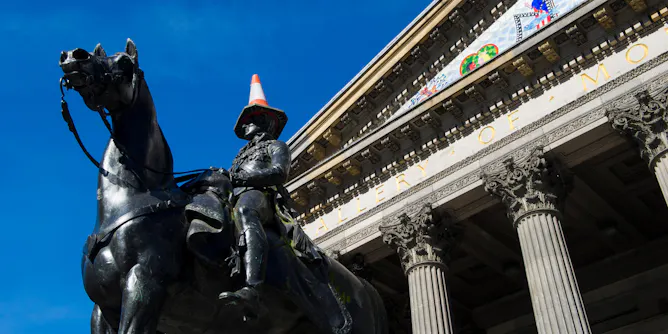
Glasgow welcomes the world’s most famous graffiti artist, drawn to the city by the much-loved ‘Coneheid’ Duke of Wellington statue outside his exhibition.
Articles on Misogyny
Displaying 121 - 140 of 282 articles

Efforts to disrupt online misogyny need to focus on stopping online forums from becoming misogynistic echo-chambers.
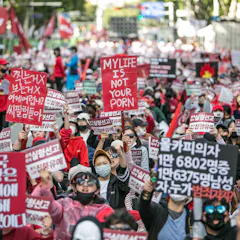
The South Korean government’s embrace of gendered citizenship has fueled the virulent gender war between men and women, with digital sex crimes used as ammunition.

In focussing on individual “deviancy”, we fail to make the connection between misogyny and wider social problems, like pornography.

Scottish police leaders have insisted the force is distinct from policing elsewhere in the UK.

The rarely explained term is nebulous at best, and can mean many things – negative and positive – to different groups of people.

Addressing online misogyny is a community-wide responsibility.

There seems to be a vacuum for these influencers to fill.
Finance is not inherently masculine. Rather, it was long constructed as such by the institutions which sought to exclude women.

Changing institutional culture means creating a hostile environment for racists and misogynists.
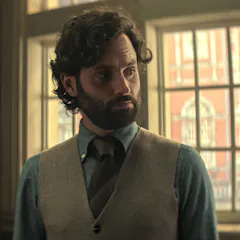
Season four of You delves into the misogyny and monstrous behaviour that can lurk beyond university facades.

From Happy Valley to social media, women police officers face rampant sexist abuse.
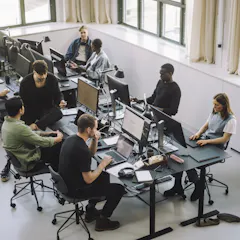
Women are severely underrepresented in tech. Strength in numbers – communities for women and women mentoring women – can counter tech’s sexist culture and help retain women in the field.

Interviews with women officers show the extent of misogynistic culture within police forces.

The manosphere may not strictly be centred on misogyny, but in young men’s search for connection, truth, control, and community at a time where all are increasingly uncertain and ill-defined.

A BBC Wales investigation reported claims of a ‘toxic culture’ of sexism and misogyny within Welsh rugby’s governing body.

The tools for reach and influence that the internet provides might be unprecedented. But people like Tate are simply pedalling the age-old sexist views that fuel gendered violence.

Those who feel disenfranchised from mainstream leaders are vulnerable to falling for the promises of online ‘leaders’ and ‘alt-moral entrepreneurs’.
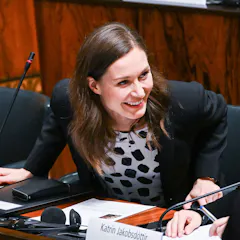
Why age and gender are such prominent mechanisms of exclusion in parliaments and governments.

If some progress was made in the early 2000s, austerity measures from 2010 saw the push for equality, diversity or inclusion die down.
Top contributors
-

Lecturer, Monash University
-
Lecturer in Australian Politics, UNSW
-
Professor of Sociology, School of Social Sciences, Monash University
-
Associate Professor at the Health Services Management Centre, University of Birmingham
-
Professor of Cybercrime and Gender, University of Portsmouth
-
Professor in the Department of Sport and Exercise Sciences, Durham University
-
Senior lecturer, College of Business Law and Social Sciences, Nottingham Law School, Nottingham Trent University
-
Professor in Sociolinguistics, University of Nottingham
-
Professor, Department of Sociology & Anthropology, University of Guelph
-
Associate Professor, School of Education, Adelaide University
-
Associate Professor, Faculty of Law, Centre for Human Rights and Legal Pluralism, McGill University
-
Senior lecturer, University of Technology Sydney
-
Lecturer in Criminal Justice and Social Policy, School for Business and Society, University of York
-
Program Director | Instructor | Internship Coordinator, School of Health and Human Performance, Dalhousie University, Dalhousie University
-
Director of the Information Integrity Initiative, a project of TheNerve/Professor of Journalism, Chair of the Centre for Journalism and Democracy, City St George's, University of London