

South Africa’s minibus taxi industry contains extensive knowledge, organisation and social practices developed by the people who work in and depend on it.
Articles on Minibus taxis
Displaying all articles

Electric taxis are a long-term climate solution whose immediate value lies in cleaner air, lower operating costs, lower noise and better urban health.
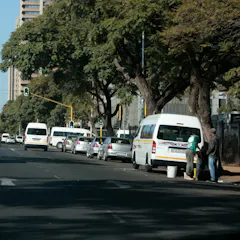
Reform must recognise that the sector’s social capital is its strength and its weakness.

Travelling remains time-consuming, precarious, and shockingly dangerous for most South Africans 30 years after apartheid has ended.
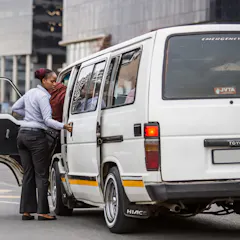
The participants all said they often felt anxious and hypervigilant when commuting.

Who the taxi strike affected, where and how shows the violent reality of the city’s spatial injustice.

The industry’s prices and profits would be lower if laws were enforced.
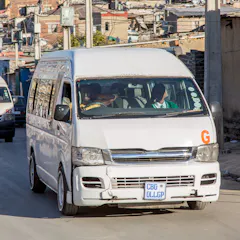
Metropolitan municipalities are best placed to administer operating subsidies for minibus taxis.
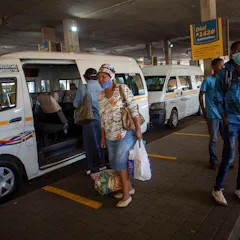
The role of government should be to improve and reorganise this sector to address the needs of users. The proposed national operational subsidy is an opportunity to do precisely that.

It is vital that the latest move by government towards restructuring succeeds in making the industry safe, reliable and viable, contributing to the country’s economy.
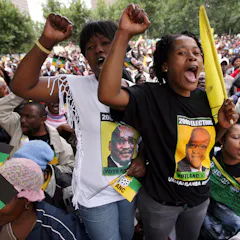
Author shows how politicians intent on settling problems by physically eliminating opponents tap into a ready source of assassins from within the taxi industry.

The taxi industry carries 75% of commuters daily, yet, unlike bus and train operators, does not benefit from government subsidies.
Top contributors
-

Senior Researcher, UNESCO 'Oliver Tambo' Chair of Human Rights, University of Fort Hare, University of Fort Hare
-
Lecturer on Sociology, Harvard University
-
Associate Professor, University of Cape Town
-
-
Research Officer in Transport Studies, University of Cape Town
-
Associate Professor, University of Johannesburg
-
Professor in Engineering, Stellenbosch University
-
Post-graduate student in Electronic Engineering, Stellenbosch University
-
Senior Lecturer in Clinical Psychology, University of Pretoria
-
Lecturer, Culture and Media department, Birkbeck, University of London