
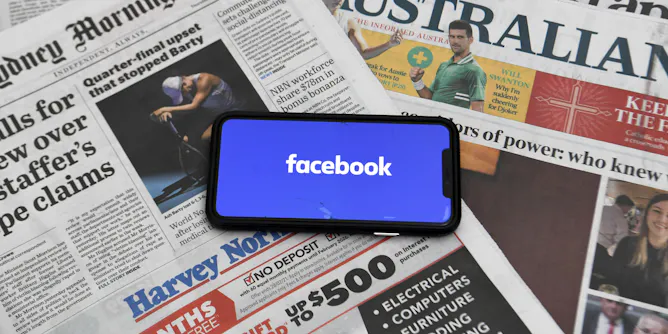
Implementing a levy on companies like Google and Meta to pay for news media would be difficult. But there is a way forward.
Articles on Media Bargaining Code
Displaying all articles

The news page on Facebook will go, and with it, the flow of money to some Australian media outlets. But will the news content disappear too?

Across Australia, the top ten regions for socio-economic disadvantage are based in rural and regional areas. Local newspapers are especially important in such communities.
ABC funding is not registering as an election issue even though it will drop in real terms over the next three years.
Rather than a royal commission focused on News Corporation, the best approach would be an inquiry into ways to maintain standards and better fund public interest journalism.

We are unable to fund news organisations in the way we used to.

In China, a lot of news happens entirely inside the WeChat platform. Is this the future for Facebook?
Facebook might not have been able to cut off news sites were it not for the draft code. Whatever comes out of this is unlikely to be more competition.
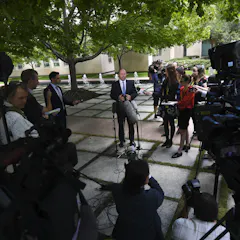
The timing of Google’s deals raises questions, coming just as the News Media Bargaining Code is set to be introduced into federal parliament.

It may have seemed the platforms were taking a confident stance by appealing to Australian users directly. But really, it was a delayed and panic-based reaction.

All sorts of transactions are “two-way value exchanges” in which it isn’t clear in which direction the money should flow. The proposed media bargaining code is one of them.
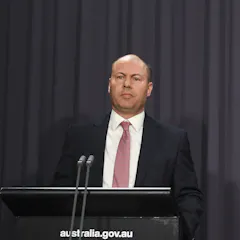
The Morrison government will introduce legislation forcing Google and Facebook to face arbitration if they fail to come to commercial deals with traditional media on payment for content
Top contributors
-

Associate Professor, School of Media and Communication, RMIT University
-
Professor (Communication), Deakin University
-
Professor, Journalism, RMIT University
-
PhD candidate in media and communications, University of Sydney
-
Professor of Strategic Management, University of Toronto
-
Senior Lecturer, Communications and Media Studies, Monash University
-
Senior Research Associate in Media and Communications, University of Sydney
-
Honorary Professor of Public Policy, Australian National University
-
Professor of Communication, Deakin University
-
Professor, School of Economics, The University of Queensland
-
Lecturer in Professional Practice (Communication), Deakin University
-
Adjunct assistant professor, Centre for Creative and Cultural Research, University of Canberra
-
Visiting Fellow, Crawford School of Public Policy, Australian National University
-
Research Fellow at Melbourne Law School, The University of Melbourne
-
Professorial Fellow, University of Canberra