
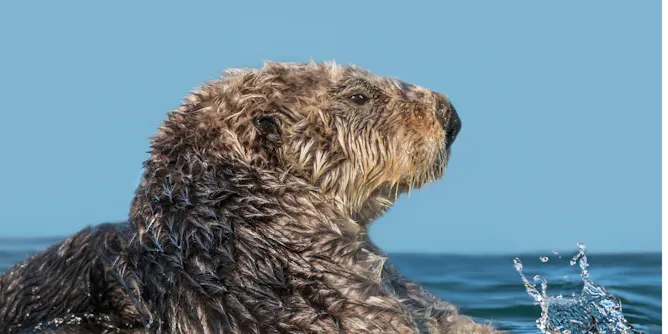
New research finds that ‘leaky mitochondria’ help keep sea otters warm.
Articles on Marine mammals
Displaying 21 - 40 of 48 articles
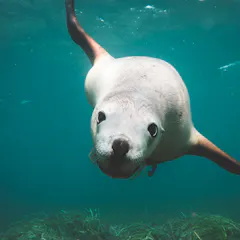
Lo, a California sea lion, was able to control what she perceives using her whiskers — a highly cognitive skill.
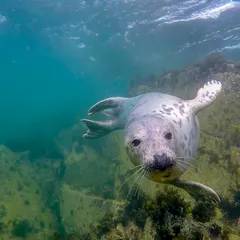
New research combines cutting-edge engineering with animal behaviour to explain the origins of efficient swimming in nature’s underwater acrobats: seals and sea lions.
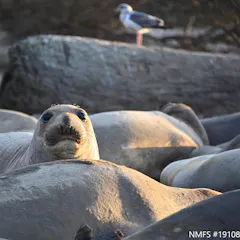
By measuring how and when elephant seals sleep, researchers were able to figure out how elephant seals change their risk-taking behavior as they gain weight.
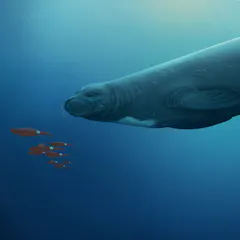
This newly discovered ancient monk seal is challenging previous theories about how and where monachine seals evolved. It’s the biggest breakthrough in seal evolution research in about 70 years.
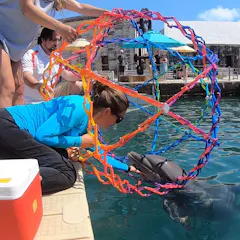
Wild dolphins are fast, smart and hard to study, but it is important to understand how human actions affect their health. So we are building a drone to sample hormones from the blowholes of dolphins.

Arctic cod are key prey for seals, whales and seabirds. What happens when ship noise drives them away?
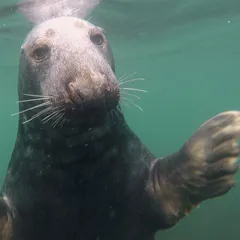
Clapping underwater takes real strength. But wild grey seals can do it, to warn off competitors and attract potential mates.

The long tusk of the male narwhal earned these whales their fanciful nickname. But there’s more to these Arctic mammals than their unique spiral tooth.

How did whales that feed on tiny prey evolve into the largest creatures on Earth? And why don’t they get even bigger?

Regulations have lowered mercury emissions globally, but the risks to ocean ecosystems and human health may be getting worse.

We don’t know for sure which one is smarter, because not everyone agrees on what “intelligence” means. Both have their own special behaviours and skills and we can’t say who is more intelligent.
Diving animals are incredible athletes.
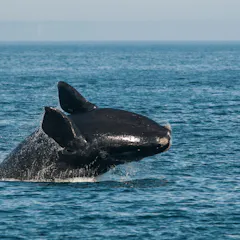
North Atlantic right whales are headed toward a traumatic extinction, but could rebound if humans can get out of their way.
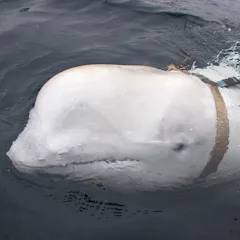
Russia isn’t the only nation suspected of training marine mammals for military use – the US, UK, and Ukraine have all done so in the past.

Protecting forests and wetlands, which absorb and store carbon, is one way to slow climate change. Scientists are proposing similar treatment for marine animals that help store carbon in the oceans.

Climate change is shrinking Arctic sea ice and opening the region to ship traffic. Whales, seals and other marine mammals could be at risk unless nations adopt rules to protect them.
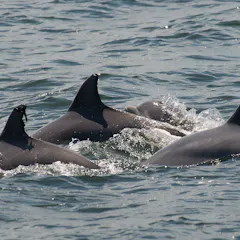
How can marine preserves best protect sea creatures that move in and out of them? Two ocean scientists describe new thinking about designing marine protected areas.
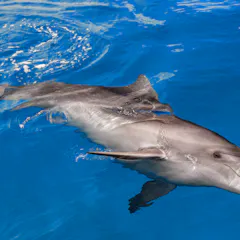
A new report will supply some information needed for science based conservation measures in the Red Sea.
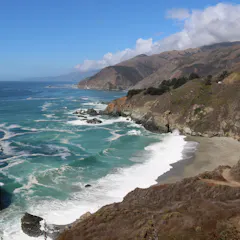
For 50 years California has used laws and policies to manage development along its 1,100-mile coastline and preserve public access to the shore. Climate change will make that task harder.
Top contributors
-

Curator of Vertebrates, Museum of New Zealand Te Papa Tongarewa
-
Adjunct Research Associate, Monash University
-
Associate Professor of Biology, Stephen F. Austin State University
-
Associate Professor of Aquatic and Fishery Sciences, University of Washington
-
Senior Lecturer in Comparative Physiology & Behaviour, Manchester Metropolitan University
-
Post-doctoral fellow, Mammal Research Institute, University of Pretoria
-
Director, Florida Program for Shark Research and Coordinator of Museum Operations, Florida Museum of Natural History, University of Florida
-
Pew Fellow in Marine Conservation, University of St Andrews
-
Associate Professor, The University of Queensland
-
Postgraduate researcher in Animal Behaviour and Acoustics, UNSW
-
Postdoctoral Researcher, Murdoch University
-
Professor Evolution & Ecology, UNSW
-
Assistant Professor of Environmental Studies, University of Colorado Boulder
-
Senior Lecturer in Physiology, The University of Queensland
-
Associate professor, Stellenbosch University