
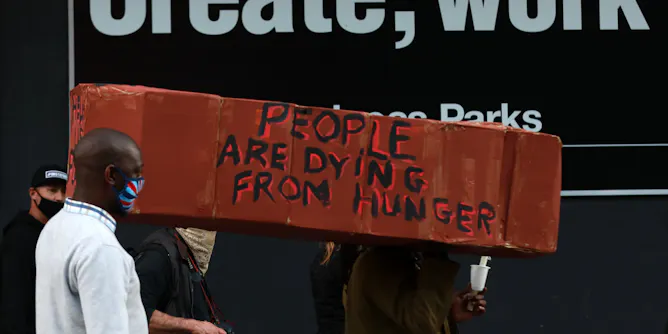
The data concerning both the spread of the virus and the indirect consequences of the lockdown indicates that no similar action is justified moving forward.
Articles on Lockdown
Displaying 301 - 320 of 558 articles

We are not all in this together.

Our findings suggest critical shortcomings in how new homes and neighbourhoods are designed.

The focus, for some time, has been on new daily case numbers. But what if we are looking at the wrong figure? We should focus on the average number of cases “under investigation” over the last 14 days.

We interviewed Victorians working — or not working — in the arts during the pandemic lockdown to learn about their mental health. We found they are struggling.

An overwhelming majority of respondents didn’t think that their life under lockdown and wider pandemic conditions affected their mental health.

The suggestion that ‘reckless’ young people and students are the root cause of a second Covid wave is problematic, unhelpful and not true.
We’ve become used to having autonomy over health decisions, which is what makes fresh restrictions so jarring.
We’re likely to see clusters of cases pop up and outbreaks that are hard to stamp out. But we can’t stay in lockdown forever. We have other options.

Emergency welfare relief during the pandemic shows ‘transformational’ child poverty action is politically and economically possible.

Let’s not shut the debate down.

From reading more to re-reading safe favourites, there are early signs that the COVID-19 has influenced how and what we are reading.

Online learning is not automatically inferior to face-to-face teaching.
Cut yourself some slack. For most people, the pandemic has been a unique challenge.

Folklore isn’t a whimsical fancy - it’s happening all around us all the time.
Students can still have a good experience at university this year – if universities take their needs and concerns seriously.

New research finds that while some women thrived during lockdown, others found breastfeeding to be difficult and overwhelming.

Fewer patients attended hospital with mild strokes during the spring, but the reasons behind this are a mystery.

Lockdowns have a key role in controlling COVID-19 but we must be aware of the risks of isolating people who are vulnerable to suicidal distress.

Despite taking different approaches, both countries have won praise for their handling of the coronavirus outbreak. So what can we learn from that?
Top contributors
-

Chair in Epidemiology, Deakin University
-
Pro Vice-Chancellor, Climate, Sustainability and Inequality and Director, Southern Centre for Inequality Studies, University of the Witwatersrand
-
Associate Professor, Epidemiology, Deakin University
-
Former Dean of the Faculty of Health Sciences, University of the Witwatersrand
-
Chair of Social Security Systems Administration and Management Studies, Adjunct Professor in the School of Governance, University of the Witwatersrand
-
Reader in Health Economics, Centre for Health Economics, University of York
-
Professorial Fellow, University of Canberra
-
Professional Research Fellow, Victoria University
-
Professor of Philosophy of Science, Durham University
-
Scientia Professor of Economics, UNSW
-
Senior Researcher, Southern Centre for Inequality Studies, University of the Witwatersrand
-
Dean Faculty of Health Sciences and Professor of Vaccinology at University of the Witwatersrand; and Director of the SAMRC Vaccines and Infectious Diseases Analytics Research Unit, University of the Witwatersrand
-
Professor of Philosophy, University of the Witwatersrand
-
Research Fellow in Health Economics, University of York
-
Professor of Public Health, University of Sheffield