
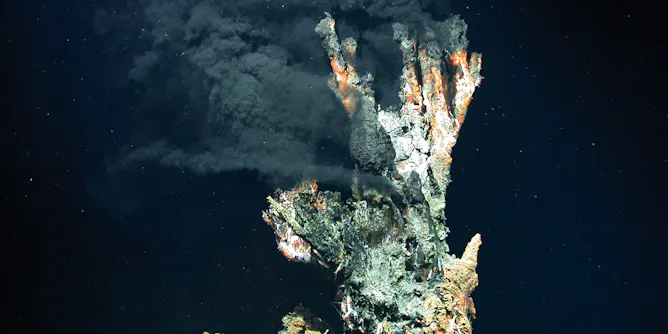
Researchers have discovered that chemical reactions in underwater hydrothermal vents could have produced the necessary ingredients for life on Earth.
Articles on Life on Earth
Displaying all articles

Highly detailed fossils are typically found in shale or other fine-grained sedimentary rocks. These ones? They’re made of iron.
The microbes living here were dramatically disrupted – and the future of life on Earth changed.
The very early Earth may not have been as inhospitable as scientists thought, with life perhaps starting more than 4 billion years ago.

Over two billion years from now, Earth will no longer be able to sustain life. A new study looks at how much life has ever existed and what this means for the discovery of new life-supporting planets.
For decades, scientists have tried to uncover the cause of long-term changes in Earth’s biodiversity. New simulations point at geography playing a critical role.
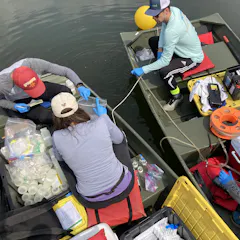
An unusual lake with distinct layers of low-oxygen and high-iron water lets researchers investigate conditions like those in the early Earth’s oceans.
Universities must be considered as not only in crisis but also as drivers of crisis in a world of climate change, biodiversity loss, authoritarianism and deep social and economic inequalities.

Lightning strikes may have helped spark life on Earth, and may be continuing to help life start on other Earth-like planets.
The Earth’s magnetic field was most likely weaker when life evolved on our planet than it is today.
Considering what we know about the key ingredients for life’s formation on Earth, here are three explanations for how this process may have occurred on our sister planet.

Modern science clashes with the idea that the rise of Homo Sapiens was a fluke.
Top contributors
-

Associate Researcher, Australian Centre for Astrobiology, UNSW
-
Royal Society Dorothy Hodgkin Research Fellow of Evolutionary Genetics , University of Bath
-
PhD Candidate, Department of Anthropology, Columbia University
-
PhD Candidate, University of Sydney
-
Earth sciences researcher, Centre national de la recherche scientifique (CNRS)
-
Associate Professor in Theoretical Geophysics, University of Leeds
-
Professor and Director of the Australian Centre for Astrobiology, UNSW
-
Associate Professor of Geophysics, University of Leeds
-
Associate Professor of Geology, Iowa State University
-
Senior Research Fellow in Geology, Curtin University
-
Professor, Environment and Development Sociology, The University of Queensland
-
Associate Professor of Geochemistry, University of Leeds
-
PhD Candidate, Earth & Planetary Sciences, Yale University
-
Assistant Professor, Earth Sciences, Carleton University
-
PhD Candidate, Université Grenoble Alpes (UGA)