
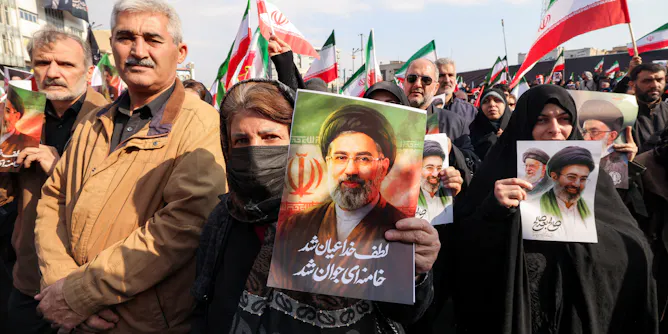
Several people on the list are deeply embedded in Iran’s political, intelligence and security architecture.
Articles on Islamic Revolution
Displaying all articles
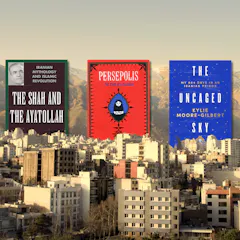
These 5 books explore Iran’s Islamic Revolution through religion, politics, mythology and personal experience – and take you inside its prisons.

Left-wing radicalism dominated the 1970s – until the 1979 Iranian Revolution became a catalyst for ‘a new and different energy’.

The 75-year-old pop star is part of a generation of Iranians in the diaspora who are watching, with bated breath, as their compatriots seek to topple the Islamic Republic.

Negotiations are possible between the US and Iran, but they will neither be easy nor likely to produce more than limited outcomes.
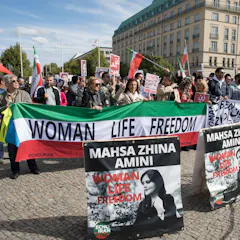
Throughout history, women who protested against the state or were seen as trouble makers were dubbed ‘mentally ill’.

Iranian artists are showing renewed determination to promote freedom as a cultural necessity in Iran, even in the face of a government crackdown.

Iranian women have often used images of actions such as singing and dancing unveiled to show what freedom means to them and to protest the Islamic Republic’s gender oppression.
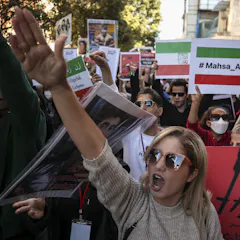
Morality police first appeared in Iran soon after the Islamic Revolution of 1979. But similar forces were present in parts of the Middle East even prior to the date.

As calls for greater freedom grow, the author examines how secularism might work in Iran.
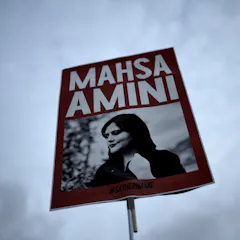
Iranian women have a long history of campaigning for their rights. The latest protests bring together a host of religious and gender groups suppressed by the country’s clerical regime.
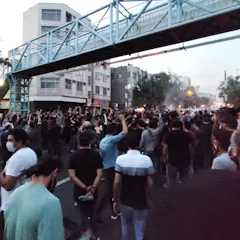
Since the 1979 Islamic Revolution, women in Iran have been forced to accept second-class citizenship, as Shiite religious leaders control most aspects of women’s lives.
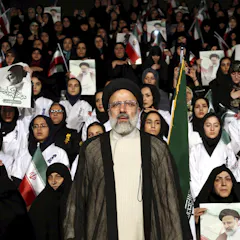
Ebrahim Raisi was declared the winner of Iran’s June 18 presidential election, which critics called rigged after his top opponents were disqualified.
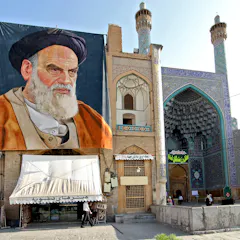
Reformists are calling for the emancipation of religion from a state that’s seen to exploit Islam for purposes of political power. This remains the most formidable challenge to Iran’s ruling clergy.
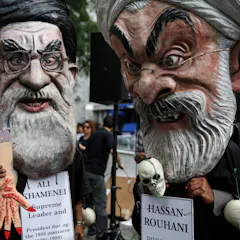
11 activists have died in prison since Iran’s mass protests were crushed in January. Now, some detainees’ families are keeping a daily vigil outside jails. It’s a sign that unrest in Iran is not over.
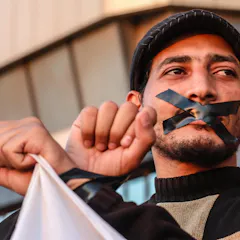
The rise of Islamic State and its declaration of the caliphate can be read as part of a wider story that has unfolded since the formation of modern nation states in the Muslim world.
Top contributors
-

Assistant Professor of Modern Languages, University of Central Florida
-
Research Fellow, Cambridge Muslim College & Teaching Fellow, SOAS, University of London
-
Senior lecturer, National School of Arts, Australian Catholic University
-
Associate Professor of Art & Design, UMass Lowell
-
PhD Candidate in Political Science, University of Oregon
-
Philosophy Tutor, University of Oxford
-
Director, Executive Leadership Academy, University of California, Berkeley
-
Ph.D. Candidate in Comparative Literature, University of California, Santa Barbara
-
PhD candidate, Communication Studies and Media Arts, McMaster University
-
Henry J. Leir Professor of Practice in Economics of the Middle East, Brandeis University
-
Lecturer in Law, Royal Holloway, University of London
-
Senior Lecturer, Discipline of English and Writing, University of Sydney
-
Professor of Practice in International Relations, USC Dornsife College of Letters, Arts and Sciences
-
Clinical Associate Professor of Ophthalmology, The University of Western Australia
-
Postdoctoral Research Fellow, College of Creative Arts, Design and Humanities, Adelaide University