

Each year, millions of Shiite Muslims walk to Karbala to honor Husayn, the prophet’s grandson, whose death continues to shape their faith.
Articles on Ayatollah Khomeini
Displaying 1 - 20 of 34 articles
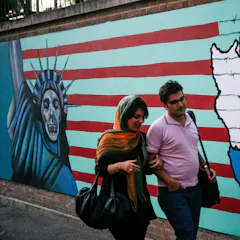
Rhetoric on both sides has gone from criticising the behaviour of their adversary to labeling its character as fundamentally ‘evil’.
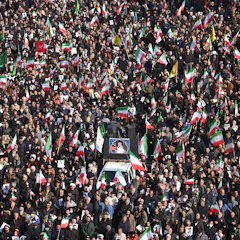
Although the supreme leader assumes the majority of power, Iran’s regime consists of a network of governing bodies.
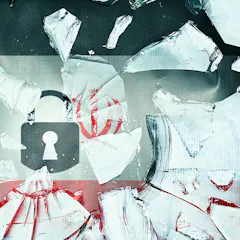
The war that began Feb. 28 hews to a familiar, dangerous pattern, writes an Iran expert, from deep, historical mistrust and incompatible strategic interests to miscommunication and misperception.
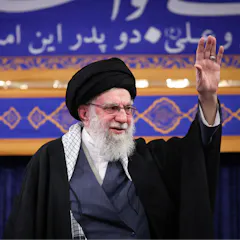
Khamenei will largely be remembered for the profound weakness his leadership brought the Islamic Republic.
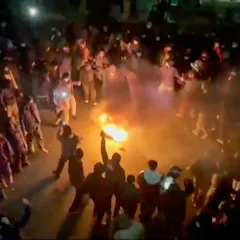
Since late December, Iran has been rocked by unprecedented unrest, which is fuelled by the economic crisis and exacerbated by violent repression by the regime.

The demands of Iran’s ethnic minorities differ from many of those in Tehran, and they have reason to fear the return of the Pahlavi monarchy.
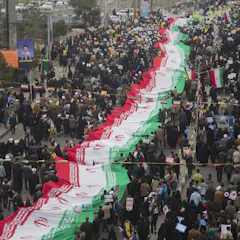
Time and time again, foreign powers have meddled in Iranian politics.
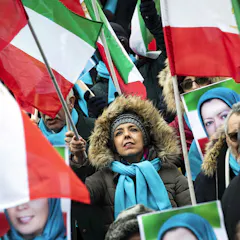
Iran is highly fragmented and doesn’t have a long tradition of democracy or a unified opposition movement. So what happens if the supreme leader is toppled?
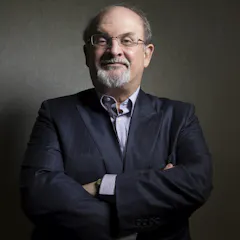
Correspondence between Malaysia’s Mahathir Mohamad and Britain’s Margaret Thatcher showed how differently the Muslim world and the West viewed the book.
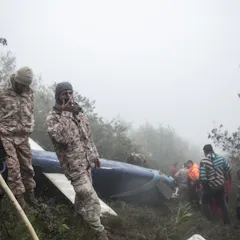
Iran’s president and foreign minister killed in helicopter crash – we ask an expert what might happen next.

After seven decades of oppression, Iranians yearn for democracy and are willing to risk their lives to win it.

Increasing numbers of Iranians want a government of the people, not a monarchy or an Islamic theocracy.

Iranian women have often used images of actions such as singing and dancing unveiled to show what freedom means to them and to protest the Islamic Republic’s gender oppression.
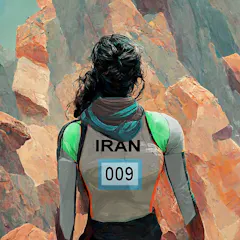
The protesters have been strongly supported by Iran’s actors, musicians and athletes who have been among those arrested, imprisoned and tortured.
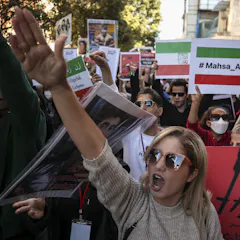
Morality police first appeared in Iran soon after the Islamic Revolution of 1979. But similar forces were present in parts of the Middle East even prior to the date.
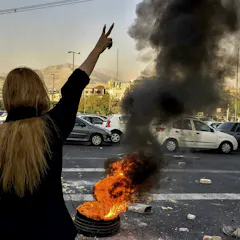
The veil as a symbol of oppression has once again moved to center stage in Iran, but it’s important to know about the history of veiling – and mandatory unveiling.
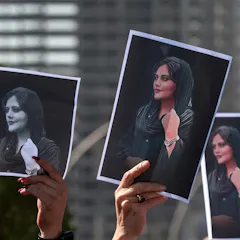
A scholar of Iranian politics explains how Iranians have organized resistance movements for the past several decades while risking arrest and public flogging.
The attack on Salman Rushdie promptly led to speculation on whether the attacker had been influenced by the 1989 fatwa against the author. A scholar explains what a fatwa is, and isn’t.

The fatwa against Salman Rushdie has political significance beyond the threat to free speech.
Top contributors
-

Senior Lecturer in Sociology, University of Manchester
-
Professor of International Politics, Clinton Institute, University College Dublin
-
Affiliated Faculty of Bioethics, Religion, and Society, Department of Religious Studies, DePaul University
-
Henry J. Leir Professor of Practice in Economics of the Middle East, Brandeis University
-
Director, Executive Leadership Academy, University of California, Berkeley
-
Professor of Anthropology, Emerita, Concordia University
-
Assistant Professor of Modern Languages, University of Central Florida
-
PhD Candidate in Political Science, University of Oregon
-
Associate Professor of Comparative Literature and Middle Eastern/South Asian Studies, University of California, Davis
-
Associate Professor Islamic Civilisation, Near & Middle Eastern Studies, Trinity College Dublin
-
Professor of History and International Affairs, University of North Carolina at Chapel Hill
-
Reader in Political Science and International Relations, Aston University
-
Ph.D. Researcher, International Security and Foreign Policy, Virginia Tech
-
Professor in the History of Art Islamic Art and Architecture, Yale University
-
Professor of Political Science, Université Laval