

With funding for a government food voucher program ending and Parliament prorogued, many Inuit children in Nunavut may soon go hungry.
Articles on Indigenous food insecurity
Displaying all articles
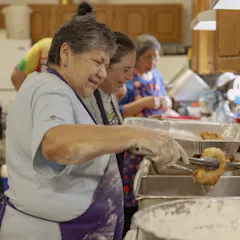
Frybread — a simple, versatile “comfort food” for many Indigenous communities — embodies the contradictions that have dictated Indigenous food and health in North America since colonization.

Tackling food insecurity in Canada needs a more systemic, structural approach that moves beyond relying on reactive, short-term solutions like food banks.

A drop in food prices might immediately address the lack of economic access to food but will not address the root causes of food insecurity.

Many Indigenous people in Australia and Aotearoa New Zealand are lacking food security due to public health orders preventing them from traditional food sourcing.
Plus, the discovery of the first known burial in Africa. Listen to episode 16 of The Conversation Weekly.

A tax on sugar-sweetened beverages may be intended to improve health, but for Indigenous consumers, such a tax would be unethical, contravene tax law and undermine Indigenous rights.

Hydrogen-filled cargo airships could do for the Northern economy what the railways did for Western Canada 125 years ago. It’s time to lift the antiquated ban on hydrogen gas for use in blimps.
Top contributors
-

Assistant Professor, Sustainability and Environmental Studies, St. Thomas University (Canada)
-
Assistant Vice Chancellor, Maori & Pasifika, Lincoln University, New Zealand
-
Research scientist, School of Human Nutrition, McGill University
-
Associate Professor of Allied Health Sciences, University of Connecticut
-
Professor of Urban and Environmental Policy and Planning, Tufts University
-
Senior Lecturer Indigenous Health, Australian National University
-
CENIEH Director, Atapuerca Research Team and author of "Homo imperfectus" (Ed. Destino), Centro Nacional de Investigación sobre la Evolución Humana (CENIEH)
-
Associate lecturer, Australian National University
-
Assistant Professor, Governance, Law and Management, Athabasca University
-
Professor of Supply Chain Management, University of Manitoba
-
Professor of Economics, Baylor University
-
Assistant Professor of Nutritional Epidemiology, University of Manitoba
-
Program Assistant, Food First NL; PhD candidate in social psychology, Memorial University of Newfoundland
-
Postdoctoral Researcher in Food, Health and Inequities, Carleton University
-
Master's Student, Research Assistant, University of British Columbia